
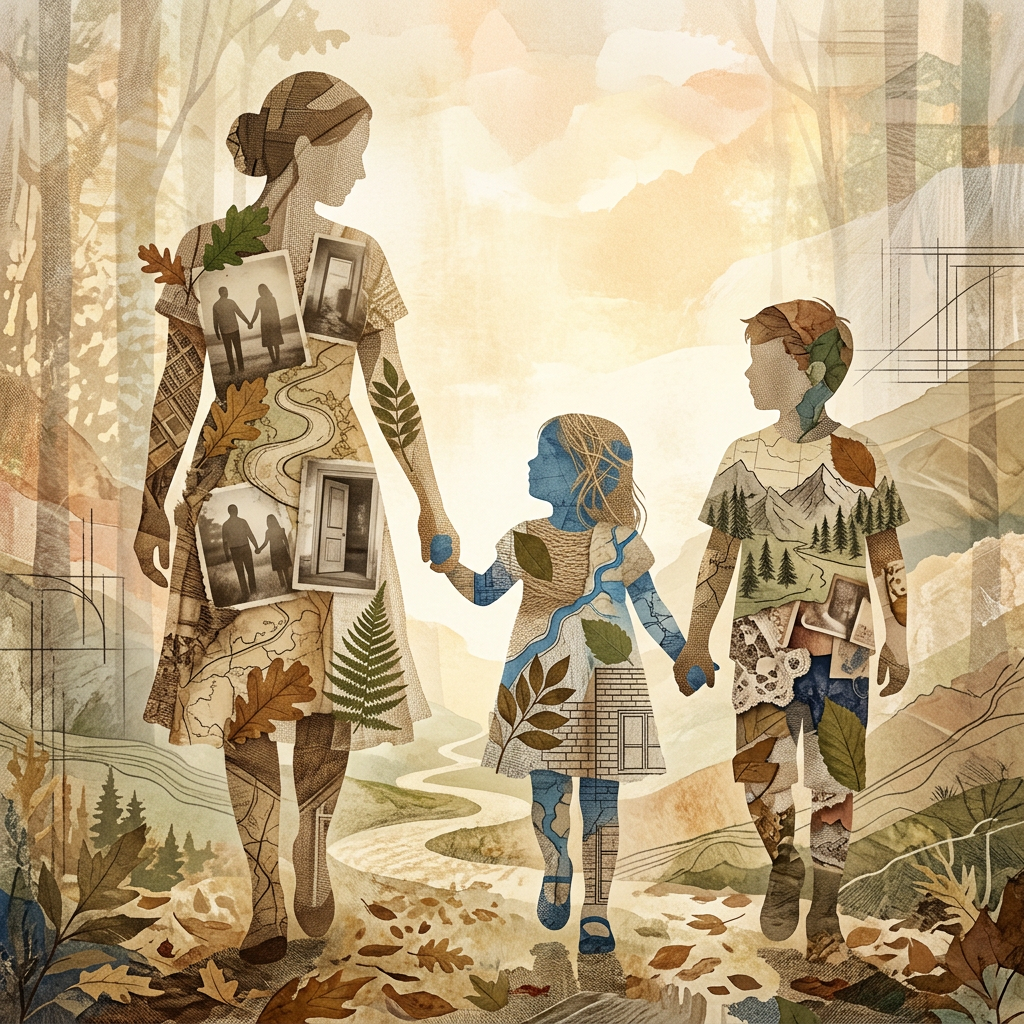
Examining Identity Before Protection Becomes Exclusion
In the first reflection, Before We React, we explored the importance of creating space between disturbance and response:
Pause.
Observe.
Ask what actually happened.
Distinguish facts from interpretation.
Notice what feels threatened.
But once we have done that, another question appears.
It is more difficult because it asks us not only to examine the other side.
It asks us to examine ourselves:
What exactly are we trying to protect?
Sometimes the answer seems obvious:
our culture,
our values,
our community,
our history,
our way of life,
our political principles,
our family,
our religion,
our country,
our identity…
These things can be profoundly meaningful.
They help human beings locate themselves in the world.
They tell us where we come from.
They connect us with people who lived before us and with people living beside us.
They can provide continuity when the world changes rapidly.
So identity deserves recognition.
But recognition should not mean immunity from reflection.
Identity can contain things worth protecting—and things worth changing.
That distinction lies at the heart of this second step toward conscious rebalancing.
1. Identity Is Not One Thing
We often speak about identity as if it were a single object:
“My identity.”
“Our identity.”
“National identity.”
“Cultural identity.”
…
But identity is usually made of many layers.
A person can simultaneously be:
a parent,
a German,
a Vietnamese,
a European,
a scientist,
a Christian,
an artist,
a village resident,
a migrant,
a teacher,
a football supporter,
a member of a political movement,
a friend…
These identities overlap, but they are not identical.
Some become important in one situation and less important in another.
Some are inherited.
Some are chosen.
Some change during life.
Some become stronger precisely because they feel threatened.
Social psychologists Sonia Roccas and Marilynn Brewer describe social identity complexity as the extent to which people recognize that their different group memberships do not perfectly overlap. A person who understands themselves through several cross-cutting identities may have a more complex social identity structure than someone who experiences all important memberships as defining one single “us.”
Research by Brewer and Pierce found that greater social identity complexity was associated with greater tolerance and acceptance of out-groups in their study.
This suggests an important possibility:
The problem may not be having strong identities. The problem may begin when one identity becomes so total that every other human difference is interpreted through it.
2. Identity Gives Us Belonging
Identity performs important human functions.
It tells us:
“These are my people.”
“This history matters to me.”
“These values help guide me.”
“This place feels like home.”
“This tradition connects me with something larger than myself.”
…
Without some continuity of identity, human life could become disorienting.
So when people defend identity, we should not automatically interpret that defence as irrational, primitive, or intolerant.
They may be protecting something deeply meaningful.
But here we encounter the central problem.
The question: “Does this matter to us?”
is different from: “What are we entitled to do in order to preserve it?”
That difference is crucial.
3. Three Layers of Identity
For the purposes of this project, it may be useful to distinguish three broad layers.
They are not rigid scientific categories.
They are a reflective tool.
Layer One — Identity That Sustains Meaning
These are elements that may support:
dignity,
belonging,
language,
relationships,
memory,
moral commitments,
cultural practices,
personal history,
continuity between generations….
These aspects often deserve protection.
For example:
preserving a language,
remembering historical experiences,
celebrating cultural traditions,
maintaining meaningful community relationships…
None of these inherently requires another group to lose dignity.
Layer Two — Identity Narratives That Can Be Reinterpreted
These are stories groups tell about themselves:
“People like us have always been…”
“Our country stands for…”
“Our community does things this way…”
“People from our region are different because…”
Such narratives may contain truth.
But they are interpretations of history, not history itself.
They can evolve.
And they often do.
What a nation believes itself to be in 1900 may differ profoundly from what it believes itself to be in 2000.
So this layer deserves neither automatic rejection nor automatic preservation.
It deserves examination.
Layer Three — Identity Claims That Require Others to Have Less
This is where protection becomes more problematic.
An identity claim may imply:
“For us to belong fully, they must belong less.”
“For our culture to remain legitimate, theirs must remain subordinate.”
“For our group to feel secure, their political voice must be restricted.”
“For our tradition to continue, they must not have the freedom to live differently.”
At this point, identity no longer concerns only the person or group holding it.
It begins determining the permissible identity of somebody else. And that is where deeper reflection becomes necessary.
4. Identity Deserves Recognition—but Not Immunity from Reflection
A phrase such as: “This is part of our identity.” can explain why something matters.
But it cannot by itself settle whether the practice should continue unchanged.
A useful follow-up question is:
Does preserving this aspect of our identity require another person or group to have less dignity, less freedom, less voice, or less opportunity to belong as themselves?
If the answer is yes, identity should not end the conversation.
It should begin a more difficult one.
This does not mean judging previous generations by simplistic standards.
Nor does it mean dismantling every inherited tradition.
It means accepting a basic ethical principle:
Something can be meaningful to us and still deserve examination.
France and Germany: When National Identity Changes Its Story
Franco-German reconciliation offers an illuminating example.
France did not cease being France after the Second World War.
Germany did not cease being Germany.
National languages remained.
Historical memories remained.
Political institutions remained distinct.
Cultural identities remained distinct.
What changed was something within the relationship between those identities.
When Charles de Gaulle and Konrad Adenauer signed the Élysée Treaty on 22 January 1963, their joint declaration explicitly described reconciliation between the German and French peoples as ending a centuries-old rivalry and fundamentally transforming relations between them.
Official Élysée Palace page on the 1963 Élysée Treaty
This is important for our discussion of identity.
French identity did not need to disappear.
German identity did not need to disappear.
But the idea that national identity must be organized around enduring rivalry could change.
We might represent the shift like this:
French identity + German identity + historical rivalry
↓
French identity + German identity + deliberate cooperation
The identities remained. The relationship encoded within them changed.
5. Historical Narratives Can Become Part of Identity
Groups do not remember history neutrally.
They construct narratives.
Those narratives answer questions such as:
Who were we?
What happened to us?
Who harmed us?
What did we overcome?
What must never happen again?
…
These stories can sustain dignity.
But they can also preserve hostility long after the circumstances that produced it have changed.
A group may gradually inherit not only:
“This happened to our ancestors.”
but also:
“Therefore those people remain dangerous.”
At that point, memory has become prediction.
And prediction can become identity.
The task is not to erase history.
The healthier question is:
What should history teach us without forcing us to reproduce its relationships forever?
6. Reinterpreting Identity Is Not Betraying the Past
This can be emotionally difficult.
When identity has been shaped by hardship, changing the story may feel like betrayal.
People may think:
“If we stop distrusting them, we dishonour what our grandparents suffered.”
Or:
“If we change this tradition, our ancestors’ sacrifices become meaningless.”
But another interpretation is possible.
Perhaps remembering suffering does not require perpetuating the relationship that produced it.
Perhaps memory can say:
Because this happened, we will build something different.
That is not forgetting history.
It is allowing history to teach rather than imprison.
Franco-German reconciliation can be understood in precisely this way.
The history was not erased.
Commemoration did not disappear. But historical rivalry ceased to be the only imaginable future.
7. Northern Ireland: Two Identities Without One Having to Disappear
Northern Ireland provides an even clearer example of identity being central to conflict.
For many unionists, British identity was—and remains—deeply meaningful.
For many nationalists, Irish identity was—and remains—deeply meaningful.
The conflict could easily be framed as:
If Britain belongs, Ireland loses.
or
If Ireland belongs, Britain loses.
But the 1998 Belfast/Good Friday Agreement constructed a more complex arrangement.
It explicitly recognizes the birthright of the people of Northern Ireland to identify and be accepted as British or Irish, or both, and to hold British and Irish citizenship. It also embeds parity of esteem between the communities and the principle of consent concerning Northern Ireland’s constitutional status.
Official UK Government text and overview of the Belfast/Good Friday Agreement
This is remarkable from the perspective of identity.
The settlement did not say:
“Your identity is causing conflict, so weaken it.”
Instead, it created space for British, Irish, and British and Irish to coexist within the same political territory.
8. Protection Does Not Have to Mean Uniformity
This leads to another important distinction.
A community can preserve continuity without demanding sameness.
Sometimes we unconsciously assume:
“If we become more diverse, our identity becomes weaker.”
But identity need not operate like a fixed quantity that decreases whenever difference increases.
There may be another possibility:
A larger identity can contain smaller identities without erasing them.
Social psychological research on the Common Ingroup Identity Model has explored how recategorizing people from separate groups into a more inclusive “we” can reduce intergroup bias.
Yet later work has also emphasized that simply absorbing everyone into a single identity is not always desirable, particularly for minority groups whose distinctive identities and inequalities could become obscured. Researchers have therefore examined dual identity approaches in which subgroup identities remain meaningful while people also recognize membership in a larger shared group.
This is particularly relevant to human connection.
The aspiration does not have to be:
“Forget whether you are British or Irish.”
It can become:
“You may remain British or Irish while also sharing institutions, communities, and a future with people who identify differently.”
9. A Larger “We” Should Not Erase the Smaller “We”
This point requires care.
Calls for unity can sound beautiful:
“We are all one.”
“We are all citizens.”
“We are all human.”
But sometimes those statements can hide inequality.
Imagine one group saying:
“Why keep talking about your minority identity? We are all simply members of the nation.”
If the majority group’s culture already defines what “normal national identity” looks like, asking everyone to adopt the larger identity may actually mean asking minorities to disappear into the majority.
So healthier rebalancing requires something subtler:
shared belonging without forced sameness.
This is why dual identities can sometimes matter.
One might be:
German and European.
Irish and British.
Muslim and French.
Saxon and German.
Vietnamese and German…
None of these combinations guarantees harmony. But they remind us that identity need not always be organized into mutually exclusive boxes.
10. The Question Is Not “Strong Identity or Weak Identity?”
This distinction matters greatly.
The solution to identity conflict is not necessarily weaker identity.
A person who knows who they are may be more capable of encountering difference without feeling destroyed by it.
So perhaps the more useful distinction is:
Rigid identity versus Reflective identity.
A rigid identity says: “If this changes, we cease to exist.”
A reflective identity asks: “What is essential here—and what have we mistaken for essential?”
A rigid identity says: “People who question this are attacking us.”
A reflective identity asks: “Could criticism help us distinguish our deepest values from inherited habits?”
A rigid identity protects everything.
A reflective identity discriminates between what is precious and what is merely familiar.
11. Familiarity Is Not the Same as Value
This may be one of the hardest distinctions.
Human beings naturally become attached to familiar ways of living.
Familiarity can feel safe.
And when something familiar changes, the loss may feel like loss of identity.
But:
something being familiar does not automatically make it ethically valuable.
A practice can be:
old,
traditional,
widely accepted,
emotionally meaningful,
and still deserve reconsideration.
History contains countless examples.
Ideas about:
gender roles,
social class,
ethnicity,
disability,
sexuality,
political participation,…
have all been treated at different times as natural components of social order.
Many were deeply embedded in identity. Their familiarity did not make every aspect worthy of preservation.
12. Rebalancing Requires Courageous Self-Examination
When conflict arises, examining the opponent is easy.
We ask:
Why are they behaving this way?
Why are they so unreasonable?
What is wrong with their values?
Conscious rebalancing adds another direction of inquiry:
What might we be contributing to this relationship?
This does not mean assuming equal responsibility.
Sometimes responsibility really is unequal.
Nor does it mean blaming ourselves for another group’s harmful behaviour.
It means recognizing that relationships are systems.
Our boundaries,
language,
assumptions,
institutions,
symbols,
and responses…
become part of the environment to which others respond.
So we can ask:
Could something we consider protective be experienced by others as exclusion
Could something we call tradition be limiting somebody else’s freedom?
Could something we call strength be experienced as domination?
These questions require courage because the answer may occasionally be yes.
13. When Protection Becomes Domination
Protection becomes especially dangerous when the sentence:
“We need to preserve…”
quietly turns into:
“Therefore they must not…”
For example:
“We need to preserve our religion.”
does not necessarily imply:
“Others must practise it.”
“We need to preserve our language.”
does not necessarily imply:
“Others must stop speaking theirs.”
“We need to preserve cultural continuity.”
does not necessarily imply:
“Newcomers may never change anything.”
“We need political security.”
does not necessarily imply:
“Our opponents must remain permanently powerless.”
The first part may express a legitimate need.
The second may be an overcorrection.
This is one place where the rebalancing trend becomes especially important.
A genuine disturbance may exist. But the response chosen to restore balance can overshoot.
14. Northern Ireland: From Protection Through Dominance to Protection Through Safeguards
The Good Friday Agreement helps illustrate an alternative.
Political security was not designed simply by allowing one community to dominate the other.
Instead, the Agreement established structures involving the Northern Ireland Assembly and Executive, North-South cooperation, and East-West cooperation between Britain and Ireland.
Read the Belfast/Good Friday Agreement and its institutional framework
The underlying principle is significant:
Security can sometimes be created through reciprocal safeguards rather than unilateral control.
This does not remove disagreement.
But it changes the relationship between identity and power.
Instead of: “We are safe only when they cannot determine our future,”
the structure moves closer to:
“Neither community should be able simply to erase the political legitimacy of the other.” That is a different form of rebalancing.
15. What Exactly Are We Protecting?
At this point, a useful exercise emerges.
When we say: “Our identity is threatened,”
we might ask: What exactly would be lost?
Is it:
the language?
the memory?
the community relationships?
the moral value?
the ceremony?
the political power?
the social status?
the assumption that our way is normal?
These things are not equivalent.
Sometimes people fear losing identity when what is actually being challenged is privilege.
Sometimes they fear losing culture when what is changing is merely exclusive control over public space.
At other times, a community really is losing language, cultural continuity, or political representation.
The analysis must therefore be precise. We should neither romanticize every identity claim nor dismiss every concern about cultural loss.
16. Three Questions for Identity
This gives us a practical framework.
When identity becomes central to conflict, ask:
1. What in this identity needs protection?
What sustains:
dignity,
meaningful belonging,
language,
memory,
relationships,
cultural continuity,
ethical commitments?
These elements may deserve deliberate care.
2. What needs reinterpretation?
Which stories about ourselves or others may have become too rigid?
Which historical narratives assume that yesterday’s opponent must remain tomorrow’s enemy?
Which boundaries were created under conditions that no longer exist?
Which traditions can retain their meaning while changing their form?
3. What may need to be relinquished?
Which parts depend upon:
domination,
exclusion,
humiliation,
unequal dignity,
denial of another group’s agency,
permanent control over another group’s identity?
These may be the hardest elements to release precisely because they can become confused with identity itself.
17. A Healthy Identity Can Change Without Disappearing
We sometimes imagine identity change as loss.
But living identities have always changed.
Languages change.
Religious practices change.
National stories change.
Families change.
Political cultures change.
Even traditions change while people continue calling them traditions.
So perhaps we need a different image.
Not identity as a stone that must remain unchanged.
But identity as a living tree.
Its roots matter.
Its history matters.
Its continuity matters.
But growth requires new branches.
Some branches die.
Some are pruned.
New conditions change its form. The tree remains recognizably itself precisely because it remains alive.
France and Germany: Identity After Rivalry
Return once more to Franco-German reconciliation.
The 1963 Élysée Treaty did not only commemorate friendship.
It established regular cooperation between the governments in areas including foreign affairs, defence, education, and youth, while explicitly grounding that cooperation in the historic reconciliation between the two peoples.
The significance for identity is subtle.
The countries did not need a shared identity that erased national difference.
Instead, an additional identity became possible:
French and German and increasingly European partners.
The social psychology literature on more inclusive and dual identities offers a useful conceptual parallel: cooperation need not always eliminate subgroup identity; under some conditions, people can retain distinctive identities while recognizing membership in a larger shared “we.”
That does not mean Europe has transcended national conflict.
Clearly it has not. But the Franco-German example shows that identities once organized heavily around rivalry can become compatible with a very different relationship.
18. Identity Is Also Shaped Through Relationship
This leads us to a deeper insight.
We often think identity exists first: “This is who we are.”
Then relationships happen afterward.
But relationships themselves help create identity.
If another group repeatedly treats us as dangerous, we may become more defensive.
If they acknowledge us, different parts of identity may become easier to express.
If our group constantly tells stories of threat, protective identity may become stronger.
If communities cooperate repeatedly, shared identities may gradually develop.
So identity and relationship continuously shape one another. This means changing a relationship can eventually change what people feel they need to defend.
19. Do Not Ask People to Give Up Identity Before They Feel Safe
There is another important caution.
If a group feels threatened, telling its members: “Your identity is too strong” may strengthen defensive identification.
They may hear: “You want us to disappear.”
This is especially important when dealing with minorities or communities carrying histories of suppression.
Reflection works better when recognition comes first.
We might begin: “I understand why this matters to you.”
Then: “Can we examine together which part needs protection and which part is creating difficulty for others?”
Recognition creates room for reflection. Humiliation usually closes it.
20. Understanding Identity Does Not Excuse Harm
As in the first article, understanding must not be confused with endorsement.
We can understand why:
a nationalist movement feels culturally threatened,
a religious community fears loss of tradition,
a majority population feels disoriented by rapid social change,
a minority community feels vulnerable to assimilation,…
without accepting every response that follows.
The need can be understandable.
The chosen solution can still be harmful.
This distinction is fundamental to conscious rebalancing:
Understand the need without automatically legitimizing the response.
21. From Identity Defence to Identity Inquiry
When identity is threatened, the instinctive sequence may be:
Threat
↓
Strengthen identity
↓
Strengthen boundaries
↓
Defend the group
↓
Distrust outsiders
But a more reflective sequence might be:
Threat
↓
Pause
↓
Ask what feels endangered
↓
Identify what genuinely needs protection
↓
Examine inherited narratives
↓
Recognize the legitimate identities of others
↓
Revise harmful boundaries
↓
Develop overlapping belonging
↓
Protect without unnecessary exclusion
The difference is not the absence of identity. It is the presence of reflection.
22. The Second Rebalancing Principle
We can now state the central proposition of this second reflection:
Identity should neither be erased nor treated as sacred and untouchable. It should be examined. We can ask which parts sustain dignity, continuity, and meaningful belonging—and which parts depend on limiting the dignity, belonging, or agency of others.
Or more simply:
Identity deserves recognition, but not immunity from reflection.
A healthy identity is not necessarily one that never changes. It may be one strong enough to preserve what is meaningful while remaining flexible enough to transform what creates unnecessary harm, exclusion, or domination.
From Protection to Reflective Identity
The instinctive pathway may look like:
Identity feels threatened
↓
Protect everything associated with identity
↓
Harden boundaries
↓
Treat criticism as attack
↓
Exclude threatening difference
A healthier rebalancing pathway can look different:
Identity feels threatened
↓
Pause
↓
Ask what genuinely matters
↓
Protect dignity, belonging, memory, and continuity
↓
Reinterpret inherited narratives
↓
Challenge harmful claims
↓
Allow multiple and overlapping identities
↓
Build belonging without domination
This does not weaken identity.
It may make identity more resilient. Because an identity that can survive examination does not need to fear every question.
Where This Leads
But even thoughtful identities do not automatically create healthy relationships.
Two groups may understand themselves better and still distrust one another.
Historical pain may remain.
Promises may have been broken.
Institutions may feel unfair.
Communication may have become hostile.
And neither side may believe that the other will act in good faith.
So the next question becomes:
How do people begin rebuilding a relationship when trust has already been damaged?
That takes us to the third reflection in this series:
Rebuilding Trust Without Abandoning Boundaries
There we will explore why trust is not the same as blind faith, why reconciliation requires repeated evidence rather than good intentions alone, and how individuals, communities, and institutions can create cooperation while still maintaining necessary ethical and democratic boundaries.
Sources & Further Reading
Élysée Treaty and Franco-German reconciliation
The official Élysée Palace record describes the 1963 treaty as marking Franco-German reconciliation and includes the joint declaration by Charles de Gaulle and Konrad Adenauer concerning the end of the centuries-old rivalry between the two peoples.
Élysée Palace — Treaty of 22 January 1963
Belfast/Good Friday Agreement
The UK Government’s official material sets out parity of esteem, the principle of consent, identity and citizenship rights, and the institutional arrangements created by the Agreement.
UK Government — The Belfast/Good Friday Agreement
Social Identity Complexity
Roccas and Brewer introduced social identity complexity as a way of understanding how people mentally organize their multiple group memberships.
Social Identity Complexity — Personality and Social Psychology Review
Social Identity Complexity and Out-group Tolerance
Brewer and Pierce found an association between greater social identity complexity and greater inclusiveness and tolerance toward out-groups in their study.
Social Identity Complexity and Outgroup Tolerance — Personality and Social Psychology Bulletin
Common Ingroup Identity and Dual Identity
Research by Gaertner, Dovidio, and colleagues examines how more inclusive group categorization can reduce intergroup bias, while later work emphasizes the importance of dual identities and differences between majority and minority perspectives.
Revisiting the Contact Hypothesis: The Induction of a Common Ingroup Identity
Another View of “We”: Majority and Minority Group Perspectives on a Common Ingroup Identity
Leave a Reply