
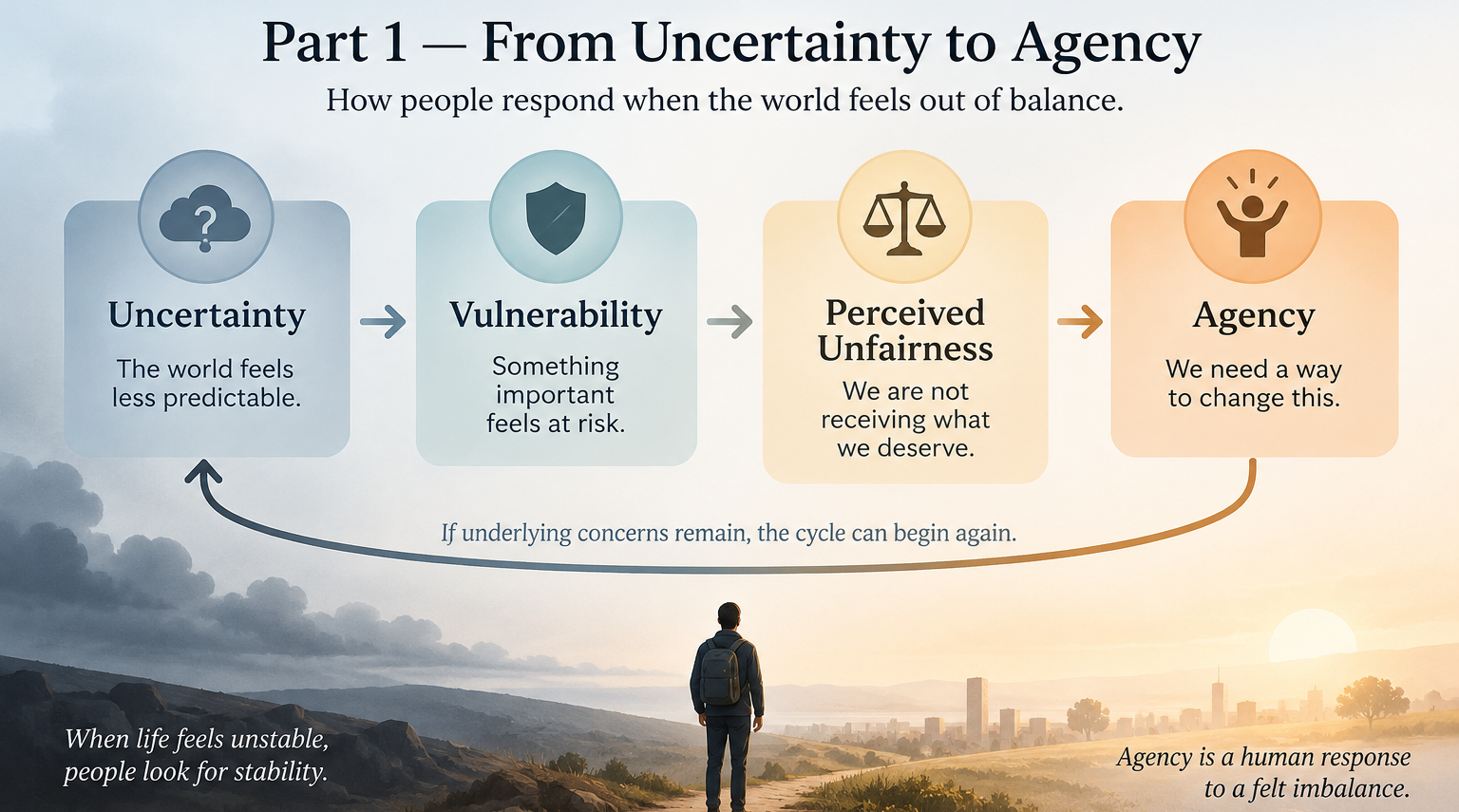
Part 1/3 — The Event and the Human Problem
On 6 September 2026, voters in Saxony-Anhalt produced a result that drew attention far beyond the borders of the state.
The AfD emerged as the strongest party in the election, receiving roughly 44% of the vote. It was the highest share ever achieved by any party in a Saxony-Anhalt state election. The result was historically significant not only because of its size, but because of what it appeared to reveal about the political mood of the region.
It would be easy to reduce the result to one explanation:
Migration.
Economic frustration.
East German identity.
Anger at the federal government.
Fear of social decline.
Distrust of established political parties.
…
All of these played some role.
But taken individually, none explains the whole picture.
Post-election polling showed that the most important issue for voters overall was social security, named by 25% of respondents. Peace in Europe followed at 17%, with the economy at 15%. Migration was less important across the electorate as a whole, although immigration and internal security were substantially more important among AfD voters than among supporters of other parties.
This suggests that the election should not be interpreted simply as an immigration referendum.
Something broader was happening.
People were responding to a combination of economic, social, geopolitical, and cultural uncertainties.
And that makes the election particularly interesting for the Human Connection Project.
The question we want to explore is not only:
Why did so many people vote for the AfD?
The deeper question is:
What happens when people begin to feel that the world around them is becoming less predictable, less secure, less fair, or less responsive to them?
That is where this case study begins.
- Part A — When Stability Begins to Feel Uncertain
- Sections 1–6
- Disturbance, economic background, uncertainty, rebalancing trend, social security, vulnerability.
- Part B — When Vulnerability Becomes Unfairness
- Sections 7–12
- Perceived unfairness, relative deprivation, East–West context, shared grievance, search for causes, migration as meaning.
- Part C — When People Search for Agency
- Sections 13–22
- Rebalancing, political agency, protest and identification, healthy vs. unhealthy rebalancing, competing forms of rebalancing, simplified explanations, and the transition toward identity.
- Where This Leads
- Sources and Research Anchors
1. Before Politics Comes Disturbance
Political behaviour does not begin only in political ideology.
It often begins much earlier.
A person experiences something in everyday life:
Perhaps a workplace feels less secure.
Prices rise.
Public services appear strained.
Pension rules are being debated.
A familiar industry is shrinking.
A war that once seemed distant becomes part of daily news.
A community changes demographically.
Political arguments become increasingly hostile.
Rules and institutions seem harder to understand.
…
Each of these changes may be manageable individually.
But together they can generate a more diffuse experience:
Things are no longer as stable as they used to be.
This is what we can call a disturbance.
A disturbance does not need to be catastrophic.
It only needs to disrupt the relationship between what people expected and what they now experience.
That distinction is important.
Humans do not respond only to absolute conditions.
We also respond to the difference between what we expected and what actually happened.
2. The Economic Background Was Mixed — and That Matters
It is important not to exaggerate economic decline.
Saxony-Anhalt was not experiencing total economic collapse.
Employee compensation actually rose in 2025, with average compensation per employee increasing by 5.4%. At the same time, however, the number of employees declined slightly, and average compensation still remained well below the German national average.
The broader economy also showed weakness.
Inflation-adjusted GDP fell by 0.2% in 2025, while the industrial sector declined more sharply. Manufacturing contracted, with notable weakness in sectors including automotive production, chemicals, metal products, rubber, and plastics.
Employment was also trending downward.
The number of employed people in Saxony-Anhalt fell by around 0.5% in 2025, and the negative trend continued into the first quarter of 2026, when employment was 0.8% below the level one year earlier. Manufacturing experienced particularly substantial losses.
This is precisely why simple statements such as: “People voted because they became poorer” are inadequate.
Some wages were rising.
Some economic indicators were relatively stable.
But employment in important sectors was weakening.
And income levels remained lower than national averages.
That produces a more psychologically complicated situation.
A person can be earning more than last year while still worrying that:
their industry is weakening,
their job may disappear,
their children may have fewer opportunities,
the region is being left behind,
future social benefits may become less secure,
…
Economic insecurity is therefore often about trajectory, not merely present income.
People ask:
“Where is this heading?”
That question is fundamentally about uncertainty.
3. Uncertainty Is Not Emotionally Neutral
From a neuroscience perspective, uncertainty matters because the brain is constantly anticipating what is likely to happen next.
Human perception is not simply passive reception.
The nervous system continually compares incoming information with expectations built from previous experience.
When the environment behaves approximately as expected, the world feels relatively manageable.
When expectations repeatedly fail, more updating is required.
This does not mean people consciously think:
“My predictive model is unstable.”
Instead, they may simply feel:
uneasy,
restless,
worried,
frustrated,
vigilant,
uncertain about the future.
The nervous system does not necessarily distinguish neatly between economic uncertainty, interpersonal uncertainty, and social uncertainty.
All can increase the need to monitor what comes next.
And when uncertainty persists, signals promising stability, clarity, order, control, or predictability may become especially attractive.
This is the first major mechanism in our case study:
Disturbance creates uncertainty.
Uncertainty creates a tendency to restore predictability.
In the Human Connection Project, we call this an instinctive rebalancing trend.
4. What Do We Mean by a Rebalancing Trend?
The term does not mean that people consciously say:
“I now need to rebalance my psychological system.”
Usually they do not.
It refers to a more ordinary process.
When something feels unstable, people tend to move toward something that appears to reduce the instability. For example:
uncertainty → search for clearer information
financial insecurity → saving more money
social instability → stronger community attachment
fear → stronger demand for protection
loss of control → stronger desire for agency
These are normal adaptive responses.
The important question is not whether people rebalance.
The question is:
How do they rebalance?
Because the same underlying need can lead in very different directions.
Uncertainty can encourage someone to seek more information, but it can also make simplified explanations more appealing.
Concern about social decline can motivate reform, but it can also increase receptivity to narratives that identify a single group as the cause.
The rebalancing trend is therefore neither good nor bad by itself.
It is a direction of movement.
5. Social Security Became a Signal of Vulnerability
The election polling is especially revealing here.
Social security was the single most important issue for the electorate overall.
Twenty-five percent of voters named it as decisive to their vote. Only 13% believed the federal government’s social reforms should continue exactly as planned, while 59% wanted corrections.
Saxony-Anhalt also has one of the oldest populations in Germany.
More than half of the electorate was already retired or approaching retirement age, making debates about pensions, healthcare, and long-term care especially tangible rather than abstract.
This is a useful example of how policy becomes personal.
A pension reform may look technical from the perspective of government administration.
For an individual voter, however, it may be interpreted as:
“Will I still be secure later?”
A healthcare reform may be presented as fiscal restructuring.
For an older voter, it may feel like:
“Will the system still be there when I need it?”
The same policy therefore exists on two levels:
- Administrative level: How should government finance and reform social systems?
- Experiential level: Can I still rely on the world around me?
That second level is where vulnerability enters.
6. Vulnerability Is Not the Same as Weakness
This distinction matters.
When we say people feel vulnerable, we do not mean they are weak.
Vulnerability here means:
something important can be lost, and the person is uncertain about whether they can prevent that loss.
A worker can feel vulnerable about employment.
A pensioner can feel vulnerable about future benefits.
A parent can feel vulnerable about their child’s opportunities.
A community can feel vulnerable about demographic decline.
A cultural group can feel vulnerable about continuity.
A country can feel vulnerable about security.
…
Different forms of vulnerability can then accumulate.
When several appear simultaneously, the person may experience a more generalized feeling:
“Our situation is becoming precarious.”
And once vulnerability becomes social rather than merely personal, it easily becomes political.
7. From “I Am Worried” to “We Are Losing Out”
Here we reach the second important transition.
Concern becomes more politically powerful when it is interpreted through comparison.
Post-election polling asked voters whether, compared with others in Germany, they felt they received their fair share.
Only 36% of voters overall said they received their fair share, while 51% said they received less.
Among AfD voters, the difference was even more striking:
66% said they received less than their fair share.
Only 23% felt they received a fair share.
This is one of the most important findings in the whole case.
Because it tells us that the emotional structure was not simply:
“Things are difficult.”
It was also:
“Things are unfair.”
That is psychologically different.
8. Why Fairness Matters So Much
Humans are highly sensitive to relative position.
We do not evaluate our circumstances only by asking:
“Do I have enough?”
We also ask:
“How am I doing compared with others?”
“Am I being treated fairly?”
“Does my contribution receive appropriate recognition?”
“Are other groups being prioritized?”
“Is my region being forgotten?”
…
The result is sometimes called relative deprivation.
A person does not need to be objectively destitute to experience relative deprivation.
Suppose someone’s salary increases. But they see:
other regions becoming wealthier faster,
public infrastructure improving elsewhere,
political attention concentrated elsewhere,
younger people leaving their region,
local industries shrinking,
…
The person may still conclude:
“We are falling behind.”
That conclusion can be more politically motivating than absolute poverty.
9. The East–West Dimension
Saxony-Anhalt cannot be understood without its East German history.
More than three decades after reunification, economic differences between eastern and western Germany remain visible in areas such as wages, wealth, corporate headquarters, and demographic development.
The official wage figures illustrate part of this.
Average employee compensation in Saxony-Anhalt in 2025 was around €49,500, approximately 84.8% of the German average. The statistical office noted that Saxony-Anhalt, like the other eastern states, remained at the lower end of the national ranking.
These differences do not automatically produce resentment.
But they provide a factual background against which perceptions of unfairness can develop.
Historical experience deepens that background.
Reunification brought enormous change:
enterprises closed or were restructured,
employment patterns changed,
many younger people moved west,
institutions were replaced,
social status systems changed rapidly.
For some people, reunification represented liberation and opportunity.
For others, it also involved loss.
Both can be true at the same time.
This matters because collective memory shapes how later change is interpreted.
When another period of economic restructuring arrives, it may not feel entirely new.
It may reactivate an older question:
“Are we once again expected to absorb changes decided elsewhere?”
Reuters reporting before the election highlighted this continuing East–West dimension, including economic disparities, feelings of neglect by Berlin, and distinctive attitudes toward Russia rooted partly in East German historical experience.
10. Disturbance Becomes Shared Grievance
Once many individuals experience a similar concern, something changes.
The issue is no longer: “I feel insecure.”
It becomes: “People like us feel insecure.”
That shift is socially powerful.
Shared grievance can create connection.
People discover: “I am not alone.”
They find others who interpret the situation similarly.
This can produce solidarity.
And solidarity itself is not problematic.
Collective political action is a normal part of democracy.
But the next question becomes crucial:
Why is this happening to us?
That is where explanations enter.
11. The Search for Causes
Humans dislike unresolved uncertainty.
When something feels wrong, we naturally look for causes:
Economic decline.
Government policy.
Globalization.
War.
Migration.
European regulation.
Corporate decisions.
Demographic aging.
Energy prices.
Political elites.
…
All may contribute to different parts of the situation.
Complex systems rarely have one cause.
And unfortunately, complexity is psychologically uncomfortable.
Simple causal stories can therefore become attractive.
Instead of:
“Multiple interconnected structural changes are interacting over time,”
a political message may say:
“Here is the problem.”
“Here is who caused it.”
“Here is what must be done.”
…
That kind of narrative restores coherence.
And coherence itself can feel reassuring.
12. Migration as a Symbol, Not Only an Issue
This helps us understand why migration can become politically powerful even when it is not the most important issue reported by the electorate overall.
DW’s post-election analysis noted that migration appeared less decisive to the general result than social security, peace, and economic policy.
Yet migration remained especially important among AfD voters.
Why?
Because migration can carry several meanings simultaneously.
For different people, it may represent:
humanitarian responsibility,
labour supply,
demographic renewal,
cultural enrichment,
administrative failure,
competition for housing,
public spending,
crime,
cultural change,
loss of familiarity,
…
The political response is therefore rarely to migration as a purely demographic fact.
People respond to: what migration has come to mean.
This is a key Human Connection insight.
An external event becomes socially important only after it passes through interpretation.
13. From Interpretation to Rebalancing
Now the sequence becomes clearer.
A person experiences uncertainty.
They feel vulnerable.
They compare their situation with others.
They conclude that something is unfair.
Then they ask: “How can this be corrected?”
That question marks the transition from grievance to agency.
Humans generally cope better with difficulty when they believe they can influence what happens next.
A difficult situation that feels controllable is psychologically different from a difficult situation that feels imposed.
Political participation can therefore function as a rebalancing response.
Voting is not only choosing a policy programme.
It can also express:
“I want something to change.”
14. The Search for Agency
This may help explain one of the most important dimensions of the AfD’s appeal.
The AfD did not simply offer criticism.
It presented itself as an instrument of disruption.
Its political message implied:
the existing system is failing,
and
a different direction is possible.
That distinction matters.
A voter who feels ignored by mainstream institutions may experience a disruptive party as a way to recover influence.
The emotional movement is: powerlessness → action
or: “They decide everything” → “My vote can force change.”
That is a rebalancing movement toward agency.
15. Agency Can Be More Important Than Agreement
People do not always vote for a party because they agree with every policy.
Sometimes the vote itself becomes meaningful.
It can communicate:
anger,
protest,
dissatisfaction,
rejection of existing institutions,
desire for change,
demand for recognition,
…
Over time, however, protest can evolve.
A party initially chosen because it disrupts the status quo may gradually become viewed as competent or legitimate in its own right.
After the 2026 election, surveys suggested that voters increasingly attributed economic and social competence to the AfD. One survey found 30% believed the AfD could advance the economy, slightly ahead of the CDU, while other polling found substantial confidence in the party on social justice.
This suggests an important transformation:
protest choice
can become
positive identification.
But that belongs mainly to Part 2.
For now, the important point is that political choice can restore a sense of agency.
16. The Rebalancing Trend at This Stage
We can summarize the process so far.
Disturbance
Economic, social, political, or geopolitical conditions feel less stable.
↓
Uncertainty
The future becomes harder to predict.
↓
Vulnerability
Something important appears at risk.
↓
Perceived unfairness
People feel they or their region are receiving less than they deserve.
↓
Search for agency
People look for a way to regain influence.
This is not yet extremism.
It is a recognizably human regulatory sequence.
The critical issue is how the need is interpreted and where the corrective response leads.
17. Healthy Rebalancing and Overcorrection
At every stage, the same need can produce different outcomes.
Uncertainty
Healthier rebalancing
Seek better information.
Accept complexity.
Build more reliable institutions.
Improve long-term planning.
Possible overcorrection
Demand absolute certainty.
Reject ambiguity.
Prefer simple explanations regardless of evidence.
Vulnerability
Healthier rebalancing
Strengthen social safety nets.
Improve resilience.
Support communities undergoing structural change.
Possible overcorrection
Treat unfamiliar change itself as dangerous.
Unfairness
Healthier rebalancing
Identify real inequalities.
Improve representation.
Reform institutions.
Possible overcorrection
Assume another social group is responsible for one’s disadvantage.
Powerlessness
Healthier rebalancing
Participate politically.
Organize locally.
Demand accountability.
Possible overcorrection
Conclude that only radical disruption can restore control.
This distinction is essential.
The Human Connection Project is not arguing that social concerns should be suppressed.
Quite the opposite.
If legitimate concerns are ignored, the underlying imbalance remains.
The question is whether the corrective response actually addresses the cause.
18. A Real Example of Misreading the Problem
After the election, political debate quickly focused on what lessons should be drawn from the result.
Some social organizations argued that the government should reconsider aspects of planned reforms and place greater emphasis on protecting people from insecurity and distributing social burdens more fairly.
From this perspective, the imbalance looks something like:
people already feel economically and socially insecure
and the corrective response should therefore be:
reduce immediate pressure, strengthen social protection, and restore confidence that people will not be left behind.
Meanwhile, other economists and policy experts warned against drawing the opposite conclusion — that difficult structural reforms should simply be abandoned because voters feel insecure.
Their concern was that Germany faces longer-term demographic, economic, and fiscal pressures that cannot disappear merely by postponing adjustment.
From that perspective, the imbalance looks different:
existing structures are becoming increasingly difficult to sustain
and the corrective response is:
make necessary changes now so that the system remains viable in the future.
These positions therefore do not represent a simple contrast between: “care about people” and “ignore people’s insecurity.”
Both are attempts to restore stability.
They differ in where they locate the danger and when they expect the consequences to appear.
One places greater emphasis on the danger of immediate social insecurity and loss of trust.
The other places greater emphasis on future structural instability if reform is delayed.
This gives us an important extension of the rebalancing concept.
Sometimes there is no obvious choice between balance and imbalance.
Instead, societies must choose between different rebalancing strategies, each with its own risks.
A policy that reduces anxiety today may create larger problems later.
A reform designed to improve long-term sustainability may increase insecurity in the short term.
The challenge is therefore not merely to ask: “Should we rebalance?”
but:
“What exactly are we trying to rebalance, over what period of time, and who bears the cost of the adjustment?”
That is a much more useful question.
19. Why Simplified Explanations Become Attractive
When several systems are changing at once, people experience cognitive overload:
Economic restructuring.
War.
Energy policy.
Migration.
Demography.
Climate policy.
European institutions.
Pensions.
Healthcare.
…
All require specialized knowledge.
Very few citizens can independently evaluate every dimension.
This creates dependence on interpretive narratives.
Political actors therefore compete not only over policies.
They compete over: which story makes the world understandable.
A successful political narrative usually answers three questions:
What is wrong?
Who is responsible?
What should we do?
The simpler and more emotionally coherent the answers, the more easily they can reduce uncertainty.
But explanatory simplicity has a danger.
Reality may be simplified beyond recognition.
20. The Beginning of the Human Connection Problem
This is where our case study begins to move from economics toward human connection.
Suppose someone believes:
“Our region is being left behind.”
That belief can create local solidarity.
Suppose they then conclude:
“People like us are being ignored.”
Now a social group begins to form.
Suppose finally they conclude:
“Other groups are benefiting at our expense.”
Now group boundaries begin to appear.
This does not happen automatically.
But it reveals the pathway.
The original issue may have been: economic insecurity.
The emerging issue becomes: who belongs to “us.”
This is the transition we will explore in Part 2.
21. What This Election Does Not Tell Us
Before moving forward, several cautions are necessary.
The election result does not prove that:
every AfD voter was economically insecure,
every supporter was motivated by migration,
every supporter held extremist beliefs,
economic insecurity automatically produces far-right voting,
East German identity determines political behaviour.
Nor does the neuroscience of uncertainty explain one specific person’s vote.
Human behaviour is too complex for that.
What the evidence allows us to say is narrower:
Several forms of insecurity, perceived unfairness, social concern, and political dissatisfaction were present.
Many voters reported concerns about social security, peace, the economy, and public safety.
A large share of AfD voters felt they were receiving less than their fair share.
And the AfD successfully positioned itself as an agent of significant political change.
From there, neuroscience, psychology, and anthropology can help us examine the mechanisms that may connect these conditions.
22. The Central Rebalancing Pattern
Part 1 can therefore be summarized as:
Something changes.
↓
The future becomes less predictable.
↓
People feel vulnerable.
↓
They ask whether the situation is fair.
↓
They search for an explanation.
↓
They look for a way to regain control.
↓
Political choice becomes a form of rebalancing.
The deeper question is what happens after that.
Does regained agency restore social trust?
Or does political identity begin replacing broader social belonging?
That is where Part 2 begins.
Where This Leads
The Saxony-Anhalt election suggests that political separation may begin much earlier than open hostility.
It may begin with ordinary human concerns:
Will I still be secure?
Will my children have opportunities?
Is my community being forgotten?
Does anyone listen to people like me?
Can I still influence what happens?
…
These questions are not inherently extremist.
They are questions about security, recognition, fairness, and agency.
But once people begin answering them through increasingly rigid group identities, the search for rebalancing can take a new direction.
The next stage is no longer only:
“Something needs to change.”
It becomes:
“Who understands us?”
and eventually:
“Who belongs with us?”
That is the subject of Part 2:
How Rebalancing Becomes Identity and Protection
Sources and Research Anchors
Official election context
The 2026 Saxony-Anhalt state election took place on 6 September 2026. Official election information is provided by the Statistical Office of Saxony-Anhalt.
Election issues and voter motivations
Post-election surveys by infratest dimap found social security to be the most frequently cited decisive issue, followed by peace in Europe, the economy, and internal security.
Perceived fairness
Polling found that 51% of voters overall and 66% of AfD voters felt they received less than their fair share compared with others in Germany.
Economic conditions
Saxony-Anhalt’s inflation-adjusted GDP declined by 0.2% in 2025, with larger weakness in manufacturing. Employment also declined in 2025 and continued falling in early 2026.
Wages and East–West differences
Average compensation rose in 2025 but remained below the German national average, with Saxony-Anhalt and the other eastern states still at the lower end of the national ranking.
Historical and regional context
Reporting before the election highlighted continuing East–West disparities, perceptions of neglect, and distinctive historical attitudes toward Russia in former East Germany.
Leave a Reply