
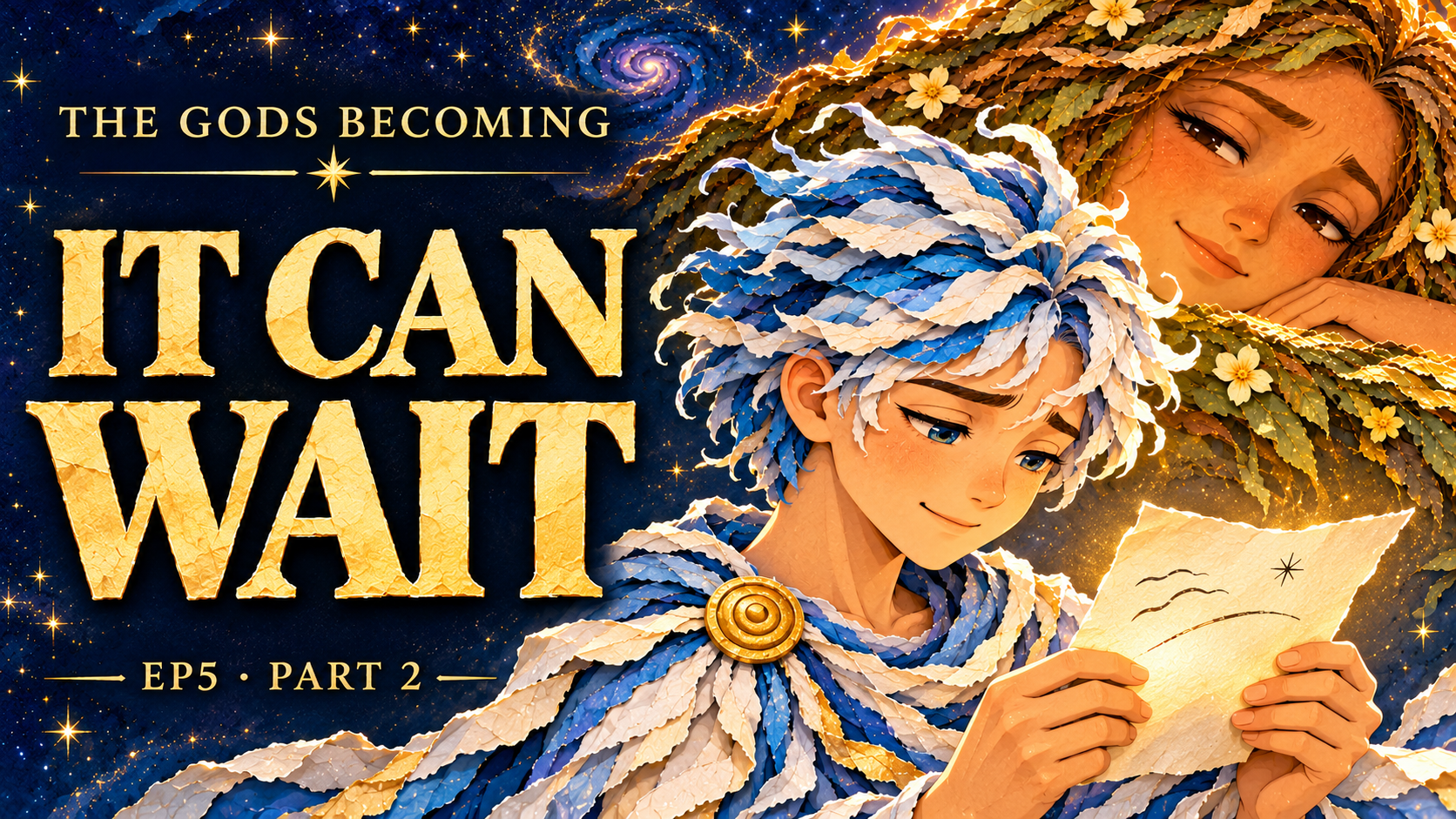
The Gods Becoming
Episode 5 · Part 2
Somewhere for a Thought to Wait

By the next time they gathered, most of the drawing was gone.
A shallow hollow remained where Erebus had pressed his hand.
The lines around it had softened.
Uranus crouched beside the sand.
“This was the place we marked.”
“Yes,” said Erebus.
“And this was…”
He stopped.
They remembered making the drawing.
They remembered understanding something while they made it.
But part of what they had understood had disappeared with the marks.

They tried a firmer patch of ground.
Erebus pressed a pointed fragment into its surface. The line remained clear when he lifted his hand.
Eros stepped nearby.
Nothing slipped across it.
This was better.
They made a larger drawing, with enough room to separate the things they had observed from the things they were still wondering about.
Later, Uranus flew out to examine the formation they had described.
Halfway there, he remembered a question.
He turned to look back.
Their drawing was too far away to read.
They began leaving marks near the places they observed.
Now they could record a discovery while it was still before them. But when they gathered beside Gaia, their accounts remained scattered across her surface.
A count beside one gathering was little help when they were trying to remember another far away.
Eros tried describing a drawing he had made on a distant ridge.
Uranus asked how one part joined another.
Eros began again.
Soon he was explaining an explanation of something he had already drawn.

Gaia listened patiently.
“Could you bring it here?”
Eros looked toward the distant ridge.
“I drew it on the side.”
“The whole side?” Uranus asked.
“I thought we might need more space.”
For a moment, they considered the ridge.
Then Gaia began to smile.
Small stones could travel.
Large stones could hold more.
They spent several days discovering how difficult it was to find something that could do both.
One surface was uneven.
Another split while Erebus worked.
A smooth fragment held a clear account, but Uranus needed both hands to carry it.
When Eros brought several smaller pieces, he set them down in the wrong order.
Their explanation acquired a very surprising ending.
Gaia laughed so hard that they had to wait before arranging it again.

One day, Uranus spread a little of his energy between his hands.
A pale shape opened there, thin enough for Gaia’s face to remain visible through it.
“Something like this would be easy to carry.”
Erebus reached toward it.
His finger passed through.
“It would also be difficult to write on.”
Uranus watched the shape fold around his hand.
Gaia studied it.
“Could you hold it still?”
He tried.
She brought a small amount of her own energy toward its edge.
Something gathered where the two met.
The pale shape thickened.
Then it dropped into Uranus’s hands.
He nearly let it fall.
“Too much,” Gaia said.
They tried again.
Gaia gave less.
Uranus spread his energy farther.
This time, the new material opened into a thin, uneven sheet.
One edge curled.
Eros touched the other.
It tore.
They looked at the two pieces in his hands.
“I barely pulled.”
“That may be useful to know,” Erebus said.

Their first sheets were difficult things.
Some crumbled when folded.
Some grew heavy as they settled.
Others were so delicate that a hurried movement pulled them apart.
Gaia began to recognize the feeling of the material gathering.
She could give it a little more substance without making it thick.
Uranus learned to spread his contribution gently, allowing the whole sheet to form before drawing his hands away.
When Gaia grew tired, they stopped.
Uranus stayed beside her.
The unfinished sheet could wait.

Eventually, Erebus held a piece that bent without breaking.
He turned it over.
Eros lifted one corner and let it settle.
Uranus carried it a short distance, returned, and placed it where Gaia could see.
It weighed very little.
They tried marking it with a pointed fragment.
The point caught and tore through.
Then Gaia suggested a dark grain that left a trace when rubbed across a pale surface.
Erebus drew a line.
He lifted his hand.
The line stayed.
Soon they were making sheets of different sizes.
They called the material paper.
Eros carried several pieces on his next journey.
Erebus took only one, then returned for more.
Uranus tried to fit an entire account onto a single sheet.
By the end, even he could hardly read it.
Gaia asked him to make the marks larger.
He sighed, found another sheet, and began again.

Their records improved slowly.
They gave familiar places recognizable marks, then added signs for movement and change. They learned to show where an account began and which part followed.
Sometimes a drawing explained what a line of symbols could not. Sometimes a few symbols saved them from making a very large drawing.
Each added a personal mark beside what they had observed. When something was unclear, the others knew whom to ask.
They also marked their visits in order and kept the earlier sheets. Now they could compare a new shape with the one they had seen before.
And beside the descriptions, their counts could remain while they turned their attention elsewhere.

One afternoon, Erebus brought an account of a formation beyond Gaia’s far ridge.
Uranus read it twice.
“So the movement underneath made the opening widen.”
“I think it may have.”
Uranus pointed at the sheet.
“It says that it did.”
Erebus looked closely.
He had recorded the opening.
He had recorded the movement.
Then he had joined them with a line.
While drawing it, he had remembered his uncertainty.
The line had not.
They returned to the account together.
Erebus showed what he had actually seen.
Gaia described a pulling sensation she had felt nearby.
Eros remembered visiting before either of them noticed a change.
Their experiences seemed related.
But they still could not tell exactly how.
So they made a different mark beside the connection.
It meant that the question remained open.
Later, when they learned more, they would return to it.

Once they could bring their accounts together, they returned to the counting.
They carried the drawings along their earlier routes, checking each place against its marks.
Two entries described the same center from opposite sides. They joined those accounts and corrected the count.
Elsewhere, what had looked like one broad gathering contained two centers whose surrounding structures kept different rhythms.
They marked both, then returned later to check.
Gaia asked them to examine a quiet place they had passed over.
“There is still movement beneath it,” she said. “I can feel it, though I cannot tell you its shape.”
This time, Eros stayed longer.
Slowly, a faint arrangement became visible around a point they had not recorded.
They added it, and checked the neighboring accounts again.

At last, after several rounds of checking, all three reached the same number.
One hundred and twenty-three.
They brought the sheets beside Gaia and went through them together. This time, they could show where each center was and how they had distinguished it from the others.
Uranus leaned back.
For once, there was no argument about the count.
Gaia smiled at their relief.
For a while, they simply looked at what they had managed to preserve.
Then Uranus touched one of the drawings.
“How does it keep holding together when the pieces around it keep changing?”
Erebus looked from that drawing to the next.
They had watched some gatherings take in material and release other pieces. They had also seen distant groups change together, though they could not trace what connected them.
“Perhaps what leaves one reaches another,” he said.
“Sometimes,” Eros replied. “But these two changed together before. This time, one began much later.”
Gaia listened.
“I feel changes reaching different parts of me. But I cannot follow all their paths either.”
They had agreed on what they could count.
Understanding how it all worked together would take longer.

In the days that followed, Uranus kept returning to the accounts.
He began arranging them around himself.
A movement on one sheet might belong with a gathering on another. A change near Gaia’s surface might explain something farther away.
Perhaps Gaia’s energy reached each place differently. Perhaps a gathering altered the energy or material that passed through it.
He moved two sheets closer.
Then three more.
The centers had become easier to recognize. Their possible connections seemed to multiply every time he looked.
Perhaps, if he could arrange them properly, he would see how everything fitted.
Perhaps he could finally know which changes might hurt her.
He found another sheet.
Gaia woke to the soft sound of paper moving.
Uranus was still beside her.
The sheets had spread farther than she remembered.
“Have you rested?”
“In a little while.”
She watched him draw a connection, study it, and rub it away.
“What are you trying to finish?”
He looked over the scattered accounts.
“I want to know what happens if this changes.”
He touched one sheet.
“Because it may affect this. And if that moves farther…”
His hand hovered over several others.
“I keep finding something else.”

During his next journey, Uranus watched a formation turn.
He should record its movement.
But first he needed to decide whether it belonged with the account from the previous day.
That depended on the distance between two smaller groups.
He had not measured that distance carefully enough.
He turned back.
Then he stopped in the open space above Gaia.
For a moment, he could not bear the thought of another sheet.

He loosened the energy he had been holding close around himself.
His form grew lighter.
The restless pressure within him softened as he spread farther into the surrounding space.
He moved.
There was no account to arrange beneath his hands.
No next line waiting to be drawn.
He followed an open current and let it carry him.
For a while, flying felt easy again.

When he returned, Eros was sitting beside Gaia.
Several sheets rested nearby.
Uranus gathered his form more closely and came down.
“How long was I away?”
“A while,” Gaia said.
He looked at her face.
“Did something happen?”
“Yes.”
His body tightened.
Gaia reached toward the sheets.
“Come closer. We saved it for you.”

The pulling near the ridge had changed.
Eros had gone to look.
Erebus had compared the place with an earlier drawing.
Gaia had felt the pressure ease.
Their account contained several questions.
It also contained enough for Uranus to follow what they had done.
He read slowly.
At one point, he looked up.
“You went back there?”
Eros nodded.
“We wanted to see whether the opening was still widening.”
“And was it?”
“More slowly.”
Uranus looked down again.
They had left space beside the observation.
He recognized the mark for a center they had counted together. He could place this new account beside the earlier ones.
While he was away, the others had kept watching.
Now he could join them where they had reached.

After a while, Gaia asked where he had flown.
He tried to describe the current that had carried him.
Then he stopped.
“I did not finish looking.”
“Did you want to?”
He considered.
“Yes.”
Gaia waited.
Uranus glanced at the papers.
“I thought I should come back.”
“I like knowing when you will return,” she said.
Her fingers rested near his hand.
“But you can tell me when you want to go.”
He looked toward the open space above them.
Then back at her.
“I could go again after we have looked at this.”
Gaia nodded.

They began leaving more room in their records.
Room for another person’s account.
Room for a question.
Room for something they might discover later.
When Uranus stopped working, he marked the place he had reached.
Sometimes he added what he wanted to examine next.
Beneath the count of the centers, he wrote another question.
“How does each hold together while changing with the others?”
He marked it as a question to return to.
It still bothered him to leave a connection unresolved.
Sometimes he returned almost immediately.
But gradually, he learned to place the sheet beside the others and let his hands become empty.

Over time, the paper began carrying things that were difficult to fit into an observation.
One day, Gaia asked what the distant formations had looked like when light passed between them.
Uranus showed her their positions.
She studied the drawing.
“And what made you stay there so long?”
He looked at the careful shapes.
They showed where everything had been.
They did not show why he had forgotten to move.
He took another sheet.
This time, his lines followed the brightness as he remembered feeling it.
Then he began shaping words around the image.

Eros discovered that some accounts were easier to remember when spoken with a repeating rhythm.
He tried the same rhythm again.
Then he changed it.
The others listened.
Soon he was making sounds that carried no observation at all.
They rose toward one another, met, separated, and returned.
He kept searching for a meeting that felt almost possible.
Sometimes Gaia joined him.

Erebus began returning to old questions simply because he enjoyed following them.
An explanation that worked around one center failed around another.
Perhaps a different condition changed the result. Perhaps he had overlooked something in the first account.
He brought the sheets together and invited the others to look.
They could now compare what each had observed, and ask how the patterns might work together.
Their discussions grew longer.
Days later, they could find the question waiting.

Gaia asked them to preserve an account of the turning place they had lost.
They disagreed about parts of it.
They wrote those differences down too.
There were things they wished they had understood earlier.
There were also things they wanted to remember because they had once brought them joy.
As they worked, Gaia listened to their voices.
The place was gone.
Yet each of them still carried something from it.
Now they could offer those pieces to one another.
Their sheets began filling with observations, questions, stories, images, and patterns of sound.
They had wanted help remembering.
They were discovering how much they wanted to share.

One evening, Uranus placed a final mark beside an unfinished account.
He looked toward Gaia.
“I am going to follow that current again.”
“How far?”
“I do not know yet.”
He considered the open space.
“But I will come back before we gather.”
She smiled.
He set the sheet beside the others.
Then he rose.
Below him, the question remained where he had left it.
For once, he did not need to carry it into the sky.

A First Beginning
They could now preserve a discovery and bring it to someone who had not been there.
They could compare their accounts, find a mistake, and leave a question for another to continue.
The record of one hundred and twenty-three centers was one small achievement they could share.
It gave them a beginning. The world around them was still changing, and they were learning how to keep looking.

The lessons they had faced would return.
They would read an old account and discover what they had left out. They would struggle to explain experiences the others had never shared. Sometimes, their own hopes would make something difficult to notice.
Their development would follow a spiral, bringing them back to familiar lessons through changing circumstances, different perspectives, and depths they could not yet imagine.
What came easily in one situation might need patient practice in another.
Sometimes they would recognize the lesson. Sometimes it would take them a long while to see that they had met it before.

Along that spiral, their small beginnings would grow.
Literature would give words to their experiences and inspirations. Music would carry their longing for harmony. Painting would give visible form to the freedom of imagination.
Philosophy would deepen their questions about how the world’s many patterns worked together. History would preserve their changing lives, their discoveries and mistakes, and all they wished to remember with gratitude.
Through them, the four would discover more of their own experience, and more of one another’s.
In time, these beginnings would become part of lives far beyond their own. Others would tell stories, make music, paint, ask questions, and preserve memories.
For now, there were four companions, a gathering of marked sheets, and a world they were still learning to share.
The next turn would begin with something they had not yet noticed.
✦
End of Episode 5 and Chapter I
Previous reading: Episode 5 · Part 1