
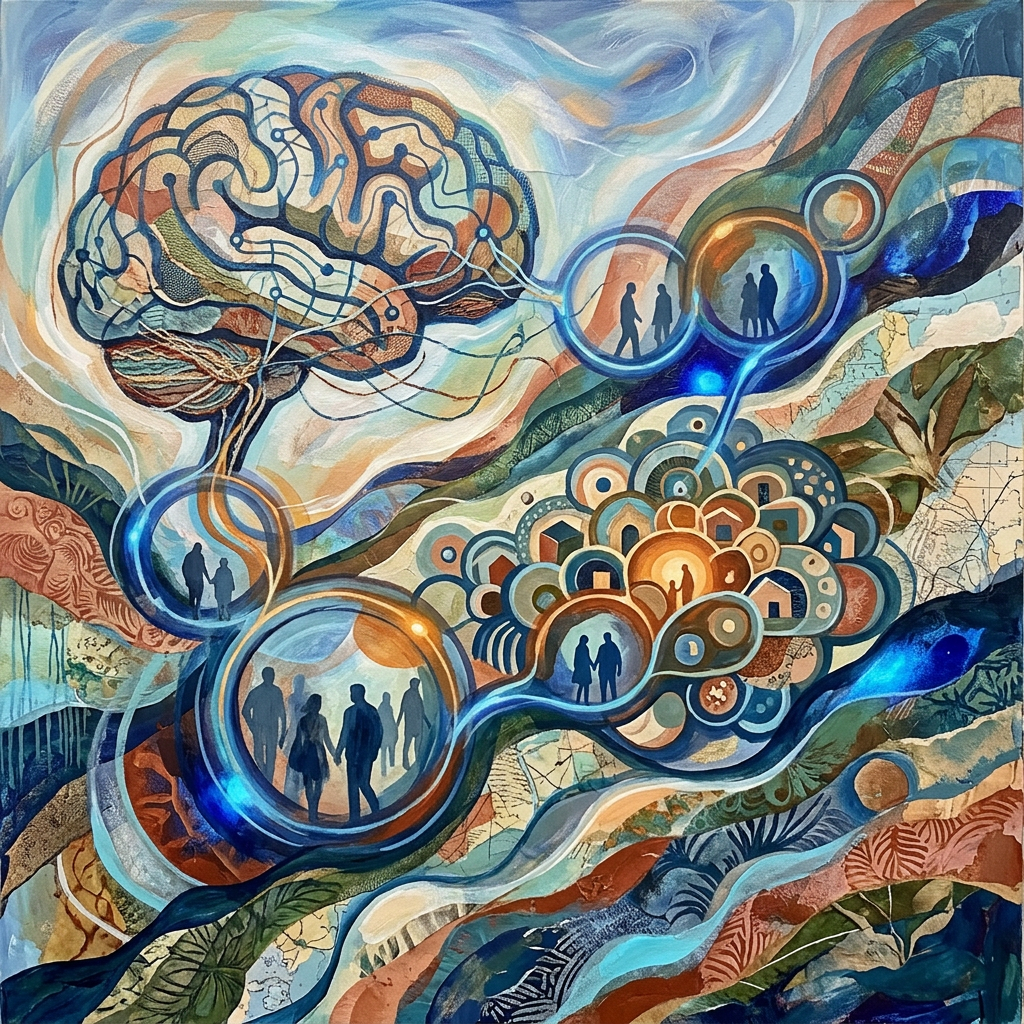
Why human interaction is where biology, psychology, and culture meet
This blog is part 3/5 of the Why Interdisciplinary Research? series, which explores how neuroscience, psychology, and anthropology can be brought together to form a more complete picture of human behavior, relationships, and culture. Each post focuses on one part of that larger connection, while the full research develops the scientific background and supporting studies in greater depth. You can find the complete series and the longer research materials on the Research Journey page.
We often speak about the individual and society as if they were two separate things:
There is the person.
And then there is culture.
But something important sits between them:
Relationships.
Culture does not enter us as an abstract force.
It reaches us through people:
Through parents,
Teachers,
Friends,
Partners,
Groups,
Communities,
Authorities,
Institutions,
Media,
Approval,
Criticism,
Imitation,
Belonging,
Rejection,
etc.
This is where the larger social world becomes personal.
And it is also where the personal can begin to become social.
That is why relationships are not simply one more topic between psychology and anthropology.
They are the bridge between them.
Culture Is Carried Through Human Interaction
A social norm cannot explain itself.
A tradition cannot teach itself.
A value cannot correct a child.
A cultural expectation needs a human carrier.
Someone says: “This is how we do things.”
Someone praises.
Someone disapproves.
Someone rewards.
Someone excludes.
Someone tells a story.
Someone repeats a ritual.
Someone models a behavior.
Someone decides what is acceptable.
…
Through these interactions, culture becomes lived experience.
A child may never hear the sentence: “Your worth depends on achievement.”
But if achievement is consistently praised while failure brings disappointment, the message can still be learned.
A family may never explicitly say: “We do not show vulnerability.”
But if emotional openness is mocked or ignored, the lesson may still become clear.
A workplace may never announce: “Competition matters more than cooperation.”
But people quickly notice what actually gets rewarded.
This is how culture enters psychology:
Not only through rules.
But through repeated relationship patterns.
Relationships Teach Us What to Expect
From early life onward, relationships help shape expectations:
Can I trust?
Will someone respond when I need help?
Is disagreement safe?
Will vulnerability bring support or shame?
Do I have to earn approval?
Is love reliable?
Will mistakes be tolerated?
Can I speak honestly?
…
These are not merely ideas.
They are learned through experience.
And once learned, they can influence later relationships.
Someone who has repeatedly been dismissed may become cautious about opening up.
Someone who has experienced reliable support may find it easier to trust.
Someone who learned that conflict always leads to rejection may avoid disagreement.
Someone who learned that boundaries are respected may feel safer expressing needs.
…
This is where psychology and neuroscience meet relationships:
Repeated social experience can shape expectations.
Expectations influence attention and emotion.
And those responses influence future behavior.
Relationships Do Not Only Transmit Culture — They Regulate Us
Human relationships do more than teach meaning.
They also help regulate emotional life:
A reassuring voice can calm.
A hostile tone can activate vigilance.
A reliable presence can create safety.
An unpredictable relationship can create uncertainty.
A supportive group can strengthen confidence.
A rejecting group can intensify self-doubt.
…
This is especially important because social experiences can feel deeply consequential even when there is no physical danger.
A person can be physically safe and still feel threatened by humiliation, exclusion, betrayal, or loss of status.
Why?
Because human beings are social organisms:
Belonging matters.
Attachment matters.
Recognition matters.
Being accepted by others can affect how safe the world feels.
This does not mean that every difficult social experience produces the same response.
But it helps explain why relationships can affect us so strongly.
We Learn Ourselves Through Other People
Identity can feel deeply personal.
But much of identity develops relationally.
People learn who they are partly through how others respond to them.
A child repeatedly told:
“You are responsible.”
“You are difficult.”
“You are clever.”
“You are weak.”
“You are talented.”
“You are too sensitive.”
…
may begin to organize parts of self-understanding around those messages.
The same happens with group identity.
We learn:
Who are people like me?
Where do I belong?
What do people like us value?
Who is outside the group?
…
Identity is therefore not formed in isolation.
It develops in conversation with others.
This does not mean that people must accept the identities given to them.
They can challenge labels,
Leave groups,
Change values,
Create new affiliations,
…
But even resistance happens in relation to something that already existed.
Relationships Can Reinforce Old Patterns
One of the most important things about relationships is that they can confirm what we already expect.
Imagine someone who expects rejection:
Because they expect rejection, they become guarded.
They speak less.
Avoid eye contact.
Hold back warmth.
Other people sense distance.
They respond less openly.
The person receives less warmth.
And now the original belief seems confirmed:
“People do not want me.”
The pattern becomes:
expectation
→ protective behavior
→ altered relationship
→ confirming feedback
This is a feedback loop.
The person is not simply observing the relationship.
They are participating in shaping it.
And the relationship, in turn, reinforces the psychology.
But Relationships Can Also Correct Old Patterns
The same process can move in another direction.
Suppose someone expects rejection.
But they meet people who respond consistently with patience, respect, and warmth.
The old expectation begins to meet new evidence.
Perhaps not immediately.
Perhaps trust develops slowly.
But repeated corrective experiences can challenge earlier assumptions.
The pattern becomes:
old expectation
→ new experience
→ uncertainty
→ revised interpretation
→ new behavior
This is one of the hopeful things about relationships:
They can carry old learning forward, but they can also create new learning.
They can reinforce fear, or soften it.
They can preserve social boundaries, or help dissolve them.
They can transmit prejudice, or provide the contact that weakens it.
…
Relationships are therefore places where continuity and change meet.
From Two People to a Culture
What happens between two people may seem small.
But relational patterns can scale:
Two people create habits.
Groups create expectations.
Expectations become norms.
Norms become roles.
Roles can become institutions.
This is how personal behavior can become cultural structure.
For example:
someone repeatedly defers to authority,
others imitate,
deference becomes expected,
expectation becomes hierarchy.
Or:
people repeatedly cooperate,
cooperation becomes trusted,
trust becomes a norm,
the norm becomes part of community identity.
The small becomes large.
And once the larger pattern exists, it begins shaping the next generation of individuals.
This is how the loop closes.
The Human Feedback Cycle
A simple way to describe the process is:
Culture gives meaning.
Psychology interprets that meaning.
The nervous system responds.
Behavior enters relationships.
Relationships reinforce or challenge the pattern.
Repeated relational patterns feed back into culture.
Then the process begins again.
So instead of thinking: brain → behavior, or: culture → person
we can think:
Brain ↔ Person ↔ Relationships ↔ Culture
This is a much more human picture.
It allows us to see that change at one level can influence the others:
A new interpretation can change behavior.
A different response from another person can challenge an old belief.
A group can revise a norm.
A culture can create new expectations.
And those new expectations can shape future minds.
Why This Matters for Empathy
When we understand relationships as feedback systems, it becomes harder to see human behavior as completely isolated.
A person who reacts defensively may be bringing old relational learning into the present.
A person who withdraws may be protecting themselves from something they expect to happen.
A person who becomes controlling may be trying to stabilize a relationship that feels uncertain.
A group that becomes rigid may be trying to protect identity or continuity.
…
This does not justify harmful behavior.
But it helps us see more clearly what may be sustaining it.
And that can change the quality of our response.
Instead of only asking: “Who is wrong?”
we can also ask: “What pattern are all of us helping to create?”
That question opens space for responsibility without reducing everything to blame.
Relationships Are Where Change Becomes Real
We can change ideas privately.
But change often becomes real when it enters interaction.
A new belief matters when we communicate differently.
A new boundary matters when we express it.
A new understanding matters when we respond differently to another person.
A cultural shift begins when enough people start relating in a new way.
…
This is why relationships matter so much.
They are where inner change becomes social.
And they are where social patterns become personal.
They are the bridge between the individual and the larger human world.
The Bigger Picture
Neuroscience helps us understand the systems that respond to social experience.
Psychology helps us understand the expectations and interpretations people bring into relationships.
Anthropology helps us understand the larger meanings and norms those relationships carry.
But the relational layer is where these influences meet in daily life.
A smile can reinforce belonging.
A rejection can strengthen fear.
A conversation can challenge a stereotype.
A repeated family pattern can become tradition.
A new way of relating can become the beginning of change.
…
This is why relationships are not secondary to understanding humanity.
They are one of the main places where humanity is continuously created.
And this leads to the next question in the series:
How do small individual and relational patterns grow into larger social patterns, group boundaries, and cultural systems?
That is where we turn next.
This is one part of the Why Interdisciplinary Research? series. In the next blog, we will explore how ordinary human patterns can scale into larger social structures—and how connection, protection, belonging, and identity can sometimes become sources of separation. Visit the Research Journey page for the complete series and the full research behind it.
Leave a Reply