
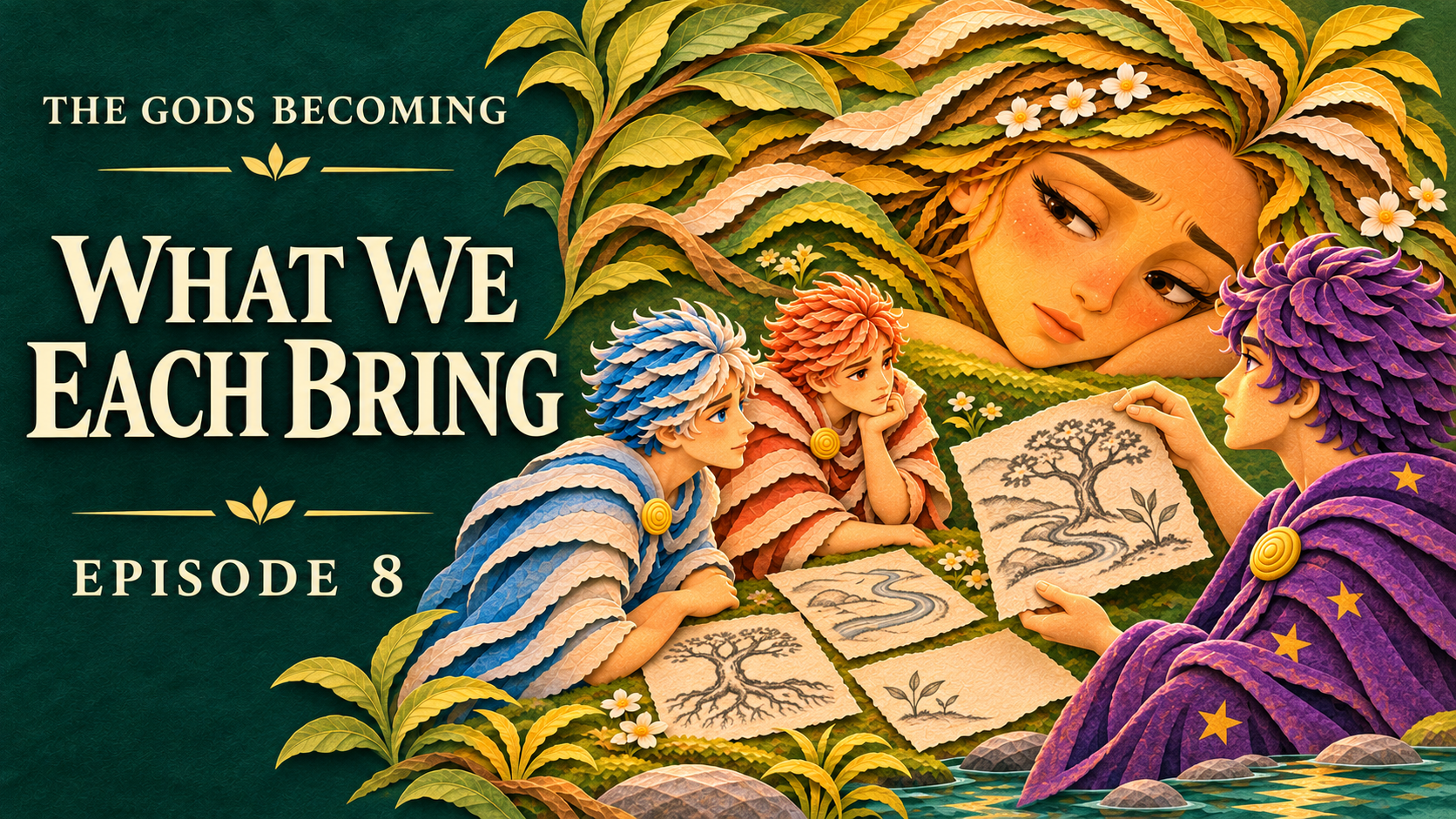
The Gods Becoming
Chapter Two · Episode 8
What We Each Bring

The next morning, they followed Gaia’s unfamiliar sensation toward a slope beyond the woodland.
It took most of the day to find a place where what she felt met something they could see.
A little water had gathered beneath a shelf of earth. Farther down, a patch of ground was softer than the soil around it.
They examined the slope, returned to Gaia, and went back again.
By evening, Uranus had begun another page.
Eros looked at the light fading between the trees.
“We have not been to the clearing.”
“Tomorrow,” Uranus said.
They had said that about several places already.
Life on Earth was not waiting for their attention. Leaves opened, roots pressed farther, and creatures changed their paths while the four decided where to go.
At the lake, the pale stone still stood above the water. Its lower edge had remained dark through their recent visits.
Erebus stopped beside it before joining the others.
The lake had become steadier. Beneath it, the routes they could not follow remained beyond their sight.
If another change began there, they would still have to wait for it to reach the shore, or for Gaia to distinguish it among her other sensations.
In the days that followed, they tried dividing their journeys.
Uranus visited the lake and the spring. Eros went to the lower hollow, then continued toward the seeds he had been watching. Erebus examined the slope where the new damp ground had appeared.
They brought their observations back to Gaia.
Sometimes their separate journeys helped. They reached places they would otherwise have left another day.
Sometimes a question sent one of them back along a path another had just travelled.
“Was the ground wet on both sides of the stone?”
“I only followed the lower edge.”
“Did the creatures return after you moved away?”
“I had already left.”

Once, a drawing seemed to show two different places as the same bend in a stream. They spent a morning discovering why their descriptions would not fit together.
Uranus added a nearby forked root to the page.
“That should make it easier.”
It did, the next time.
Other difficulties remained.
Gaia could attend to the pressure beneath the slope or to the small movement near the lake. Turning between them took time. Sometimes, while she listened to one, another became difficult to distinguish.
Eros asked whether they should bring their reports separately.
“Sometimes,” she said. “But when you are together, one of you remembers what another has not told me.”
They stayed that evening until she had asked her questions.
Erebus began returning to the older pages.
He placed the first repair beside the drawing of the spring. Then he brought the lower hollow closer.
Uranus watched him move them.
“That is not the order in which we visited.”
“I know.”
Erebus studied the three pages, then moved the first one back.
“What are you looking for?”
He took time to answer.
“At the opening, we thought about stopping the water. At the hollow, we had to think about letting some of it continue.”
Uranus nodded.
“But that is not all of it.”
Erebus reached for the drawing of the blocked passage.
After a while, he set it down without moving anything else.
There were connections he could almost follow. When he tried to explain them, they broke into separate incidents again.
The others waited.
“I need to stay with this longer,” he said.
Eros looked at the drawing of the spring.
“Do you think there was something we should have noticed sooner?”
“Perhaps. But I am also thinking about the things we did notice, and still did not know how to bring together.”
He asked for several weeks apart from their usual journeys.
Eros looked toward the pages they had brought back that day.
“Will you be going somewhere?”
“Somewhere quiet. Near enough that you can find me.”
Gaia asked what he hoped to do there.
“I keep remembering the same moments,” he said. “But they do not return in the order they happened.”
He described the seeds that had reached the dry hollow too soon, the opening Eros had waited beside, and the little pools they had almost stopped seeing while they argued over the drawings.
“I think there is something in how we met those things. I cannot hold it while I keep beginning the next journey.”
Uranus looked at the records spread between them.
“Which pages do you need?”
They spent the following days arranging what Erebus would take. He made copies of drawings the others still needed, and returned with them to the uncertain slope before leaving their daily rounds.

Eros remained beside him after the papers were gathered.
“Will you come back before you have worked it all out?”
Erebus looked up.
“If you want me to.”
“I would like to know how you are.”
They chose a day to meet again.

At first, the quiet did not bring clarity.
Erebus sat beneath a stone overhang with the pages held down around him. He read descriptions he remembered helping to make.
Water leaving the lake.
Water reaching the hollow.
A plant that returned after clearing.
A branch that would not grow green again.
He tried arranging them by place, then by what they had changed. Neither arrangement held everything he wanted to understand.
One afternoon, while he sat with the papers, a small creature disappeared beneath the edge of a stone. It returned carrying a fragment he could barely see.
Erebus watched it make the journey again.
It could reach a place he could not. Yet when he lifted his eyes to the drawings, he remembered how much they had seen clearly and still struggled to understand.
He turned over a page covered with possible routes.
On its back was an earlier drawing of the lake.
He remembered asking what they had first wanted to help.
The question had changed what they were willing to consider. They had stopped looking only for a way to recover the old waterline.
He laid that page apart.
Beside it, he placed the drawing of the plants that kept spreading over the clearing.
Here, they had remembered the purpose well enough. What they had kept repeating was the same remedy.
He looked between the two.
They had both needed another possibility. But they had arrived at the need by different paths.

On the day they had chosen, Eros came to find him.
Erebus had spread the drawings around a smooth patch of stone.
Eros stopped before stepping between them.
“May I sit here?”
Erebus moved two pages.
They talked first about the journeys Eros had made. Water still reached the lower hollow. The unfamiliar shoots beneath the fading grove had opened more leaves.
Then Eros asked about the drawings.
Erebus showed him the two pages he had set apart.
“One brings me back to what we were trying to do,” he said. “The other makes me ask why we keep doing it in the same way.”
Eros considered the clearing.
“We could ask both about that place.”
“Yes.”
“Then where does this one belong?”
He pointed to the blocked route beside the ridge.
Erebus brought it closer.
For some time, neither spoke.
“At the ridge,” Eros said, “we were still looking at the place we could not pass.”
Erebus remembered walking along the stone, and the damp trace leading sideways.
He found another space for the page.
Eros stayed until the shadows reached the drawings. Before leaving, he helped carry them farther beneath the overhang.
Over the following weeks, Erebus worked with the differences.
The dry hollow and the opening where Eros had waited came to rest together. Both had asked them to notice when a meeting could help.
Beside them, Erebus gathered the drawings of the little channels. Here, the question had been how to arrange several connections so that they could continue together.
Nearby lay the drawing of the grove.
Erebus returned to it often.
The new shoots had not restored the tree Eros remembered. Their presence did not tell the four that everything was well. Nor had the fallen branches been empty simply because they no longer carried leaves.
He remembered Gaia asking about the old leaves before she asked about the new growth.
He left room around that page.
At their next meeting, he asked Eros whether the old tree had changed. Eros told him about a living branch they had almost overlooked, and the open leaves beneath it.
Erebus added both to the drawing.
Last, he unfolded the account of the days when Uranus and Eros had begun speaking sharply.
Both had brought something the others needed. Their difficulty had grown while each tried harder to make his own concern understood.
Walking together had changed what they could hear.
Erebus placed that account where he could see it from the other groups.

The thought that eventually came to him was small enough, at first, to seem incomplete.
Someone could have followed the water.
He had wished it many times. The three could walk over Gaia’s surface and examine an exposed opening. Beyond it, stone closed around the movement.
Gaia felt within that stone. Yet her body held more sensations than she could distinguish at once.
What would it be like to meet one of those hidden places from nearby?
He imagined a living being within the Earth, close to the small movements they could only ask Gaia to describe.
Then he looked at the pages again.
Seeing the water would not, by itself, have told them whether to stop it.
They had seen the lower hollow clearly and still disagreed about what to do. They had stood beside the ridge while discussing only the blocked opening.
He began another drawing.
Beside the first imagined being, he left space for another.
When Erebus returned, he brought fewer pages than the others expected.
Uranus helped him lay them near Gaia. Eros sat beside the account of their walk between the pools and the woodland.
For a moment, Erebus wanted the quiet of the overhang again.
There, he could leave a thought unfinished without watching anyone wait for its end.
Gaia asked him where he would like to begin.
He looked toward the lake.
“With the places we could not reach.”
He described what he had imagined: living beings who could dwell within Earth and move through its material without forcing open the paths they followed.
Uranus looked up from the drawings.
“We have never made a body that can do that.”
“No,” Erebus said. “We would have to discover how, with Gaia.”
“They could come close to what is happening there,” he said. “Close enough to notice things we have only felt from far away.”

Gaia listened before asking her first question.
“How would they move through me?”
“I have been trying to imagine a form that belongs within your material. But I cannot decide that without you.”
She was quiet for a while.
A small body could be formed from her material. She had already seen stones, plants, and other lives become distinct upon her. Giving such a body its own life would not carry her awareness out of Earth with it.
She would remain here, feeling movements she could not always explain.
“I would like to understand those places too.”
He waited.
“If we try,” she continued, “I want to help shape how they pass. There are already lives within the ground.”
Erebus drew the page closer to her.
He had imagined seven beings.
Uranus counted the spaces on his drawing, then looked at the records beside it.
“Why seven?”
Erebus brought forward the first lake drawing.
He spoke about returning to the need behind an old decision, until it became possible to imagine a different beginning.

Then he showed them the clearing, where the same work had needed doing again and again.
“One might stay with what began a matter,” he said. “Another might become especially curious when the same difficulty returns.”

Eros moved the drawing of the ridge beside them.
“And this?”
Erebus smiled a little.
He described the choices that had held them at the blocked opening. A new direction had begun nearby, outside the route they were trying to recover.

“That feels different to me,” he said. “Even if we had never been there before, we might still have stood looking at only those choices.”
Uranus studied the three drawings.
“You have given them separate places.”
“For now. I wanted us to look at what each might notice.”
Erebus touched the pages that lay between two spaces.
“Some of these belong together in more than one way. Seven is how I have gathered them so far.”
The others began moving the pages too.
Eros brought the dry hollow beside the opening where Gaia had asked him to wait.
The memory made him look toward her.
“I had already decided it was time.”
“You stopped when I asked.”
He touched the drawn edge of the stone.
Erebus described a being attentive to things becoming ready to meet. Water and seed. An opening and the pressure above it. A contribution offered before another could receive it.

Eros asked whether such a being would always know the moment.
“I do not think any of us could give it that,” Erebus said.
“Then it would need to learn when to wait too.”
He moved the two drawings closer together.
Uranus took up the page of shallow channels.
“This one would need more than patience.”
He began tracing how one small change had affected the next. Some possibilities had looked alike until they examined the ground. Others had required an arrangement none of them had made before.
Erebus showed him the space he had left for a being drawn toward questions, comparisons, and the invention of new structures.

Uranus leaned over it for a long time.
Then he reached for a blank page.
They spoke longest over the grove.
Eros described the tree again. Gaia remembered the place from sensations that had become familiar over many seasons.
Erebus listened, though he had brought the drawing himself.
“What would this one do?” Eros asked.
“Stay with what a change might mean. Ask what we have not understood about it.”

“And if the tree could still be helped?”
“Then I would want it to notice that.”
Eros looked at the small marks beneath the fallen branch.
“And if it could not?”
Erebus did not answer immediately.
“I would want it to keep looking. There might be something to learn without being able to put everything right.”
Gaia asked him to leave the old tree and the new shoots on the same page.
He had nearly separated them.
The last account lay between Uranus and Eros.
Uranus read the words he had written after their disagreement. Eros remembered the pool he had been trying to describe.
Erebus spoke about the walk that had helped them hear each other.
“One of the seven could be drawn toward what happens between those trying to work together.”

“To stop us arguing?” Uranus asked.
Erebus looked down at the account.
“We still disagreed when you came back.”
“Yes,” Uranus said.
“But we knew more about why,” Eros added.
Gaia asked what this being would do if two companions needed different things.
They considered the lake and the lower hollow. Letting one concern disappear from the discussion would have made the decision easier. It would also have left someone unheard.
Eros moved the account nearer the other pages.
“It would have to notice who had not spoken.”
“And whether we had listened,” Uranus said.
Erebus added their questions beside his own.

By the time they paused, the seven spaces had changed.
Some held more drawings. Some held fewer. A single experience appeared in more than one place.
Erebus looked over them all.
He had spent weeks trying to hold their differences clearly enough to bring them back. Now the others were showing him things he had missed within the experiences he thought he remembered best.
Gaia asked how they would give the beings their different inclinations.
“Something from each of us,” he said. “Combined differently.”
They remembered their earlier creations: energy meeting energy, a small change in what was brought together altering what could continue.
Uranus began considering proportions. Eros asked how the seven would recognize and approach one another.
Gaia returned to the material of their bodies.
“I want them to be able to come near a movement without disturbing it simply by passing.”
She could imagine some of what that would require. Other parts she would have to discover with them.
They left those questions open on the page.
“Would each do only its own work?” Uranus asked later.
Erebus looked toward the account between him and Eros.
“I would not want the one who notices a beginning to leave when someone needs help with what follows.”
“Or the one who waits to be unable to act,” Eros said.
They went through the spaces again.
Every being would receive something from all four. What differed would be the balance, and the kind of attention that might come most readily.
What each became would also depend on what they encountered.
Eros looked at the seven spaces.
“Then we would be bringing lives here, before they could help us.”
Gaia answered quietly.
“They would have to learn what it feels like to be here. We would have to learn what they need.”
Uranus drew the page toward him again. Beside the routes he had imagined them following, he began marking a place where they could first stay together.
Gaia asked whether they would be small.
Erebus had imagined them that way, with small bodies and room to grow. Their size alone would not let them pass through stone. That would depend on how their bodies belonged within Gaia’s material, something the four had still to learn to shape.
“They would need us,” Eros said.
“Yes.”
He looked again at the routes beneath the lake.
“And they would meet things we have never seen.”
The thought left him quiet.
They did not begin creating that evening.
Uranus gathered the pages they would need again. Eros kept the account of the grove beside the drawings of the pools.
Gaia wanted more time to attend to the material near the place where they might begin. She described an ordinary movement within it, something she had long felt without needing to name.
Erebus listened.
For weeks, he had imagined a being coming close enough to follow such a movement. Now he tried to imagine its first encounter with it.
What would it notice?
What might it ask?
Gaia paused.
“Will you help them tell me?”
Eros answered first.
“We can try together.”
“Where shall we begin?” Uranus asked.

Gaia attended to a quiet patch of ground near the lake. She could feel a little water beneath it and roots farther to one side.
“Here, perhaps. Let me listen a little longer.”
Eros settled beside her. Uranus put the drawings away.
Erebus looked at the empty ground and tried to imagine someone looking back at him.
For a while, he forgot what he had wanted to explain.
✦
Episode 8 ends here.
← Episode 7: When Care Becomes Complicated
Watch Episode 8 on YouTube ↗
Next: Episode 9 — Seven New Voices
The Sacred Journey · Healing · Consciousness · Human Connection
Leave a Reply