Numerology and Esoteric Systems: A Balance of Insights (4) – Western Numerology’s Life Blueprint & The Tree of Life (Qabalah) – A New Approach and My Proposal of the ‘Spiral Tree Code’ Model

! Through extensive research, I’ve developed my own approach to compare and integrate Numerology and several other esoteric systems with the main focus of uncovering BALANCE at various intricate levels. Because this exploration spans numerous traditions, I’ll be sharing my discoveries in a series of articles. It’s important to understand that these insights are the direct outcome of my own research, not necessarily widely accepted public opinion. Your interest and feedback would be incredibly valuable in making this ongoing work even more comprehensive. !

Introduction on The Tree of Life (Qabalah)

The Tree of Life, according to Chic Cicero & Sandra T. Cicero from the Golden Dawn, “is the most important symbol of the Qabalah … The ten Sephiroth and the twenty-two paths which connect them are known together as the Thirty-Two Paths of Wisdom.” The Divine formed the Sephiroth through the Flaming Sword or Lightning Bolt and created the Universe, then the Serpent of Wisdom, with the aspiring to reach the Divine from the bottom, would ascend and form the 22 paths. “The Sephiroth may be described as centers of energy or god-consciousness, while that paths connecting them are conduits or energy channels.”
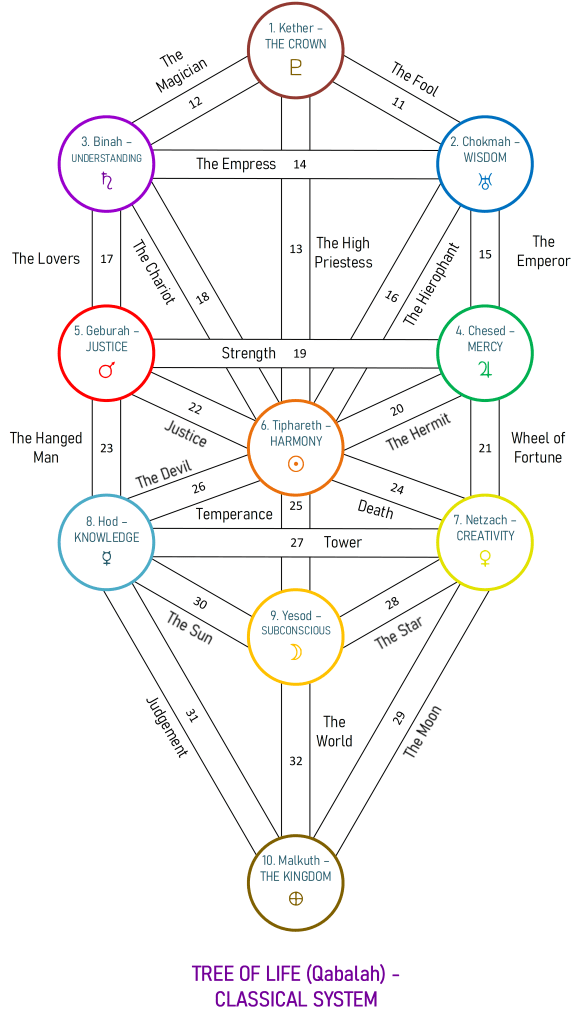
Below is the summary for the 10 Sephiroth and the 22 Paths:

NumberSephirahKey words
1KetherUnity, divine source, pure will
2ChokmahWisdom, dynamic force, duality begins
3BinahUnderstanding, structure, creative matrix
4ChesedMercy, expansion, benevolence
5GeburahSeverity, power, discipline, change
6TipharethBeauty, harmony, heart-centre, cosmic balance
7NetzachVictory, endurance, emotional mastery
8HodGlory, intellect, communication mastery
9YesodFoundation, the subconscious, manifesting energies
10MalkuthKingdom, physical world, grounded expression
Path NumberConnectionsMajor ArcanaAstrological ResemblanceResemblance Name
11Kether to Chokmah0. The FoolElementAir
12Kether to BinahI. The MagicianPlanetMercury
13Kether to TipharethII. The High PriestessPlanetMoon
14Chokmah to BinahIII. The EmpressPlanetVenus
15Chokmah to ChesedIV. The EmperorZodiacAries
16Chokmah to TipharethV. The HierophantZodiacTaurus
17Binah to GeburahVI. The LoversZodiacGemini
18Binah to TipharethVII. The ChariotZodiacCancer
19Chesed to GeburahVIII. StrengthZodiacLeo
20Chesed to TipharethIX. The HermitZodiacVirgo
21Chesed to NetzachX. Wheel of FortunePlanetJupiter
22Geburah to TipharethXI. JusticeZodiacLibra
23Geburah to HodXII. The Hanged ManElementWater
24Tiphareth to NetzachXIII. DeathZodiacScorpio
25Tiphareth to YesodXIV. TemperanceZodiacSagittarius
26Tiphareth to HodXV. The DevilZodiacCapricorn
27Netzach to HodXVI. The TowerPlanetMars
28Netzach to YesodXVII. The StarZodiacAquarius
29Netzach to MalkuthXVIII. The MoonZodiacPisces
30Hod to YesodXIX. The SunPlanetSun
31Hod to MalkuthXX. JudgmentElementFire
32Yesod to MalkuthXXI. The WorldElementEarth

My Proposal of the ‘Spiral Tree Code’ Model

According to Frater Barrabbas, 22 paths in the Tree of Life “characterize the individual cycle of spiritual transformation and personal evolution”, where each path represents “a transition from one state of emanation to the next higher (or lower).”

I’ve spent some time to contemplate on the journey of the soul in the Numerology’s Life Blueprint as well as the journey of the Fool in Tarot and in The Tree of Life, together with what I’ve experienced with the development of spirituality nowadays, how many different ways of thoughts have developed from theses two systems or others. It’s stunning to see that despite how rich and profound and abundant sources we have now on spiritual paths, teachings, and practices, they still seem to share a common thread: the emphasis on heart-centred development for cultivating consciousness and harmony. Many sources, regardless of their specific origins or methodologies, converge on the idea that true spiritual evolution depends on opening the heart, fostering compassion, empathy, and unconditional love, as well as aligning with one’s deeper soul purpose. From this fact, I felt the urge to build a ‘revised’ Model for soul’s development based on the above two systems.

Firstly, I will replace The Fool archetype with an image of a child developing – walking step-by-step through the 22 Paths of The Tree of Life – just like the way a soul begins to incarnate into the body firstly as a baby. This would make sense the integration of the Life Blueprint and The Tree of Life.

As known and accepted widely, The Fool archetype represents innocence, trust, unformed potential…; meanwhile The Child represents the beginning of development, being open to learning, being vulnerable yet cheerful… The Fool’s journey to The World signifies the soul’s ongoing unfolding process. In my model, The Child represents the soul’s entry into incarnation, starting from the 1st Sephiroth (Kether). As The Child encounters and integrates the forces of the Tree of Life, it progresses through distinct growth phases—symbolized by the Youth, Power, and Wisdom Squares—and masters the lessons of each Path or Arcana. Upon reaching The World (from Path 32), The Child has acquired the essential tools of mind, power, and desire, thereby forming a complete personality.

The replacement of The Fool with The Child in the soul’s journey is not something new, it has at least been applied quite successfully in the Patch Tarot by Spirit Studios Inc. But my second modification is presumably my very ‘bold’ move towards changing how we understand soul’s journey in the Tree of Life.

When trying to integrate the three squares of the Life Blueprint with The Tree of Life, I recognized that the soul’s journey here should be treated as an ascending cycle itself, not just transforming one way from The Child in Kether to The World in Malkuth. And this is totally consistent with the original theory of The Tree of Life: The Divine (Kether) formed the Universe (Malkuth), then the Serpent of Wisdom from Malkuth would ascend back to unite with the Divine. The Child in my model, similarly, will descend into form, identity, will, experience from Kether to Malkuth during Youth and Power Squares, and then ascends back from Malkuth to Kether – toward synthesis, service, self-transcendence – during Wisdom Square, forming a cyclical, alchemical journey of the soul. Each stage of The Child’s journey is characterized by the necessity to balance inner and outer energies and to integrate polarities through a heart-centred lens.
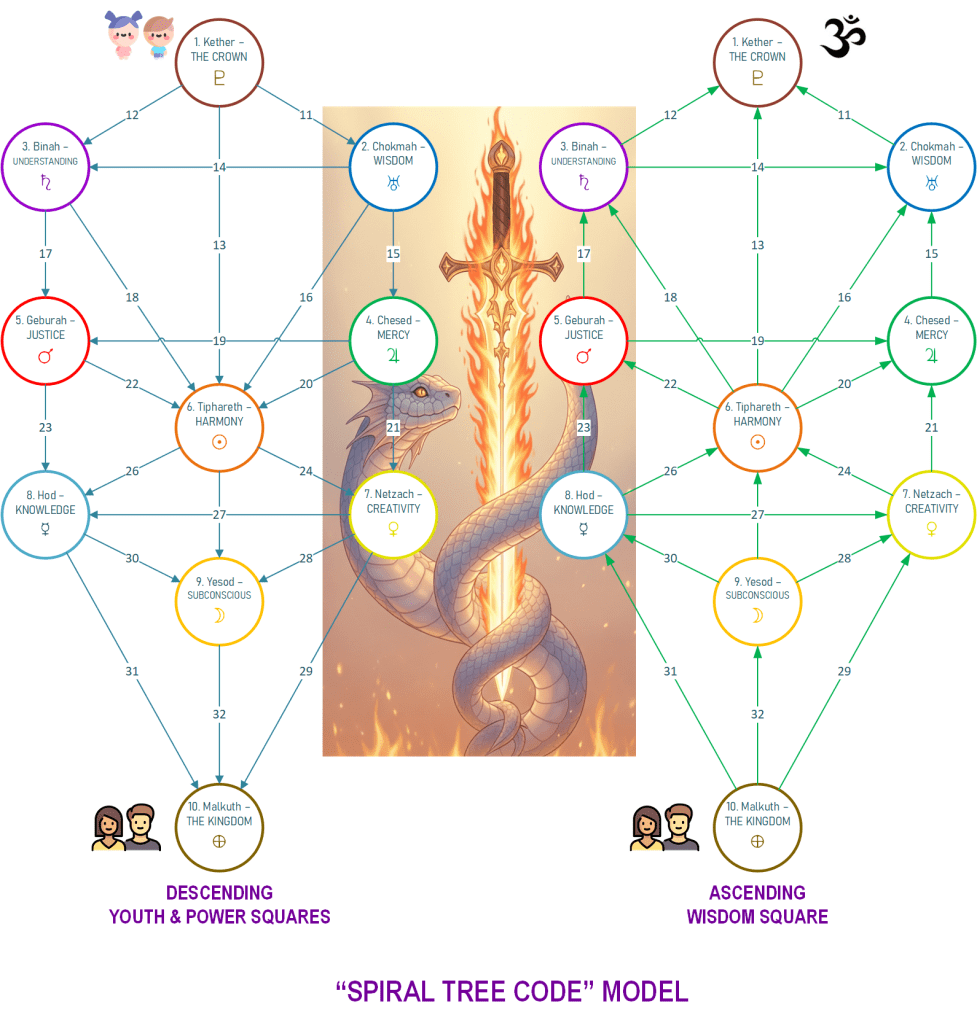
"Spiral Tree Code" Model

Below are the two summary tables of The Child’s journey in my new model (one for Youth and Power Squares, one for Wisdom Square):

Phase 1: DESCENT INTO FORM (Youth + Power Squares): The Child-Soul enters incarnation, learning to express itself in the world. Along this descend, the vibrant call of the heart may soften under the weight of external conditioning, yet its inherent balance and inner resonance quietly remain its compass.

Path No.ConnectionsMajor ArcanaDescription
Stage 1: From Spirit to Structure (Kether to Tiphareth)
11Kether to ChokmahThe FoolThe soul begins as pure potential
12Kether to BinahThe MagicianDiscovery of intellect and will; the need to balance thought with presence
13Kether to TipharethThe High PriestessEmerging inner knowing; the soul’s first call to listen inward
14Chokmah to BinahThe EmpressEmotional nourishment; connection to the mother and the harmonizing role of feeling
15Chokmah to ChesedThe EmperorStructure, law, and father energy; must be tempered by compassion
16Chokmah to TipharethThe HierophantCultural conditioning and tradition; testing the heart’s truth versus external authority
17Binah to GeburahThe LoversEmotional choice and emerging desire; balancing love for self and others
18Binah to TipharethThe ChariotPersonal direction and ego emergence; learning to steer with integrity
Stage 2: From Heart to Action (Tiphareth to Malkuth)
19Chesed to GeburahStrengthWillpower, character refinement; balancing strength with gentleness
20Chesed to TipharethThe HermitPersonal reflection, solitary wisdom; the heart’s voice becomes clearer in silence
21Chesed to NetzachWheel of FortuneEmbracing cycles and fate; trusting the inner rhythm through change
22Geburah to TipharethJusticeLearning karmic law, fairness; integrating clarity with compassion
23Geburah to HodThe Hanged ManSurrender and ego softening; balancing identity with surrender
24Tiphareth to NetzachDeathTransformation and release; letting go with trust in the soul’s cycle
25Tiphareth to YesodTemperanceInner balance and integration; heart becomes the mediator of opposites
26Tiphareth to HodThe DevilConfronting material attachment; discerning love from entanglement
27Netzach to HodThe TowerShattering false identities; clearing space for authentic heart presence
28Netzach to YesodThe StarRenewal of purpose; hope born of soul-centred trust
29Netzach to MalkuthThe MoonFacing illusions and shadow; heart-discernment lights the dark path
30Hod to YesodThe SunJoy, radiance, identity flowering; alignment of ego with inner light
31Hod to MalkuthJudgmentThe call to higher service; the awakened heart begins to guide the whole
32Yesod to MalkuthThe WorldFull manifestation in the physical realm (Malkuth); heart, mind, and soul harmonize in form

Phase 2: ASCENT BACK INTO LIGHT (Wisdom Square): The soul now reawakens to its authentic self, embarking on its return journey to Kether. This ascent is not a repetition, but a profound transmutation of every stage previously experienced. Here, balance evolves into devotion, with the heart serving as the soul’s unwavering compass.

Path No.ConnectionsMajor ArcanaDescription
Stage 3: Return Path (Reverse Spiral from Malkuth to Kether)
32Malkuth to YesodThe WorldThe world becomes a sacred mirror; heart-centred embodiment begins
31Malkuth to HodJudgmentAwakened from worldly illusion; conscience arises from the heart
30Yesod to HodThe SunRadiance becomes compassion; joy is shared in service
29Malkuth to NetzachThe MoonWisdom through deep emotion; heart holds space for mystery
28Yesod to NetzachThe StarSpiritual vision guides action; love flows without condition
27Hod to NetzachThe TowerEgo death as sacred breakthrough; balance restored through surrender
26Hod to TipharethThe DevilMastery over desire; desires purified by soul intention
25Yesod to TipharethTemperanceIntegrated harmony; the heart reconciles all duality
24Netzach to TipharethDeathRebirth into soul-centred awareness; release becomes love
23Hod to GeburahThe Hanged ManEmbrace of divine paradox; balance through trust
22Tiphareth to GeburahJusticeEquanimity and spiritual alignment; the scales held by the awakened heart
21Netzach to ChesedWheel of FortuneConsciously engaging destiny; surrender aligned with purpose
20Tiphareth to ChesedThe HermitGuiding others from wisdom; inner light radiates
19Geburah to ChesedStrengthSoul-will replaces ego-will; compassion is now strength
18Tiphareth to BinahThe ChariotDirection now soul-led; service becomes the engine
17Geburah to BinahThe LoversDivine union within; heart as sacred space of wholeness
16Tiphareth to ChokmahThe HierophantTeaching from lived wisdom; heart is the new tradition
15Chesed to ChokmahThe EmperorInner authority awakened; rule by clarity and love
14Binah to ChokmahThe EmpressNurturing others from spiritual fullness; love overflows
13Tiphareth to KetherThe High PriestessLiving from intuitive soul; the heart knows without words
12Binah to KetherThe MagicianCreative mastery through divine channel; heart aligns mind and body
11Chokmah to KetherThe FoolReturned to innocence, now enlightened; the heart becomes the throne of knowing
Development Cycle of Soul

Briefly, the journey of the Child-Soul begins in a state of pure innocence and culminates in a state of conscious innocence, reflecting the cyclical nature of the Life Blueprint Squares where Youth and Power combine in the descending journey, and Wisdom guides the subsequent ascending voyage. Each path, being experienced twice: first time as initiation and second time as integration, underscores that the balance of emotional, mental, and spiritual is not a static state but a dynamic evolution through each cycle. Throughout this transformative process, the heart serves as the guide, the bridge, and the illuminating flame at every turn.

Projecting the Life Blueprint onto The Tree of Life in the ‘Spiral Tree Code’ Model

When observing and analysing data from many people of different ages and professions, I noticed that in each development cycle in the Tree of Life, the Life Blueprint Points can usually serve as ‘Karmic Blind Spots’ or ‘Blind Justice,’ where the soul is called to confront veiled truths, particularly during its interaction processes with others. These points can manifest as hidden ego defences, unresolved emotional debts or projections, misunderstood motives stemming from past interactions, or even echoes of unfulfilled soul contracts. This ‘Blind Spot’ concept strongly resonates with the Qabalistic idea of certain Sephiroth (especially Geburah, Netzach, and Hod) acting as spiritual testing grounds, as well as astrological concepts like the South Node or Chiron wounds, and Jungian shadow complexes that become activated in relationships. Practically, these Blueprint Points serve as vital invitations for the soul to contemplate the blind spot(s)’s true impact, take ownership of their recurring patterns, and cultivate emotional maturity through a process of profound discernment and forgiveness.

Each side of the Life Blueprint squares (Youth, Power, and Wisdom) marks a distinct thematic self-work essential for progressing along its bordered path. Youth Square involves discerning the underlying conditions of circular reasonings (Side AB), observing (with new perspectives) the soul’s optical illusions to understand its vulnerabilities (Side BC), and igniting the process of self-improvement (Side CD). As the journey deepens into Power Square, the focus shifts to enacting change through strategic moves and countermoves for personal and relational betterment (Side DE), progressively laying foundations for growth while nurturing healthy shifts in interpersonal dynamics (Side EF), and bravely addressing inhibitions with creative, careful, and caring communication to achieve greater balance (Side FG). Finally, Wisdom Square calls for reflection on unresolved issues to gain clarity on their lingering influence (Side GH), assertive action to transform and settle these issues with focused readiness (Side HI), and a profound awareness of the Law of One – recognizing that true balance necessitates the strong will and collective effort of the entire community, not just individual striving (Side IA). This intricate process echoes the Tikkun HaNefesh in Jewish mysticism, emphasizing soul correction through life themes, and the Great Work of alchemy, which centres on balancing internal opposites.

Practically, these square sides offer a deeply practical framework for conscious living and relational mastery, particularly when approached with a heart-centred focus on balance. These thematic self-work stages can be applied as:

  • Mindful Relational Strategies: For the Youth sides (AB, BC, CD), this means consciously stepping back in conflicts to identify your own circular thinking patterns and emotional triggers, rather than reacting instinctively. It encourages inviting feedback from trusted, loving individuals to illuminate personal blind spots and vulnerabilities, fostering genuine self-awareness.
  • Conscious Habit Formation & Communication: The Power sides (DE, EF, FG) lend themselves to deliberate shifts in daily routines and communication. This could involve practicing Non-Violent Communication (NVC) to make changes in relationships through compassionate ‘moves and countermoves,’ or intentionally dedicating time to self-care (physical, emotional, spiritual) as the foundation for nourishing healthier interpersonal connections. The act of “bravely speaking up” (FG) transforms into assertive, yet deeply empathetic, expression of one’s truths and inhibitions, ensuring the heart’s wisdom guides the delivery.
  • Integrative Personal Development & Community Engagement: The Wisdom sides (GH, HI, IA) call for active integration. This might involve structured forgiveness practices to release old emotional debts, or engaging in mindful ritual to “inspect unchanged influences” from unresolved issues, allowing for clarity and release. Critically, the awareness of the Law of One on side IA could be translated into actively seeking collaborative solutions, participating in community projects that require collective will, and fostering environments where shared well-being is prioritized over individual gain, acknowledging that true growth blossoms from unity and mutual support.

In essence, the square sides of Life Blueprint support transforming abstract concepts into tangible actions, guiding the soul to embody its fullest potential with both wisdom and profound compassion in its journey through the world.
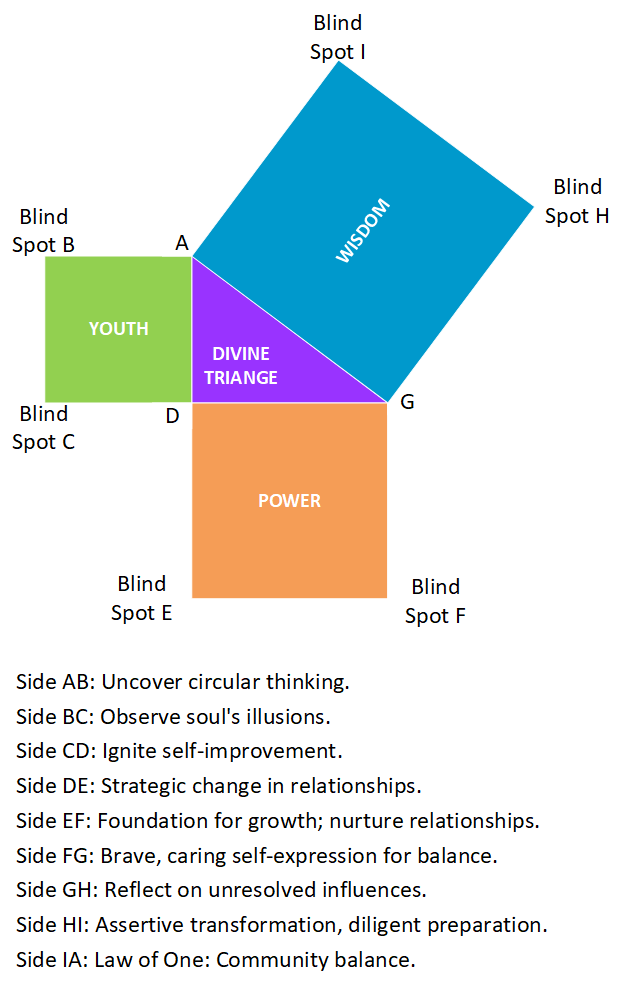
Life Blueprint's sides

The Life Blueprint’s Divine Triangle, when projected onto The Tree of Life, can naturally encompass the supernal Sephiroth of Kether, Chokmah, and Binah and threaded by Path 11, the Fool. It can also be beautifully understood as the heart’s intrinsic desire to awaken the ego. In this light, it symbolizes the soul’s profound love for its own unfolding – an inner whisper that assures us, ‘There is more to you than mere survival.’ This sacred structure represents the harmonious alignment of our deepest desires, purest will, and expanding consciousness. It powerfully echoes the original Fool’s journey in esoteric Tarot traditions, the profound concept of the soul choosing incarnation out of love, and the Kabbalistic wisdom of “descent for the sake of ascent,” where the ego is given life precisely so it can ultimately remember and reconnect with its soulful essence. Thus, these sides of the Divine Triangle act as gentle yet persistent motors of evolution, consistently guiding and nurturing the ego’s rise to conscious awareness.

Sources:

  1. Chic Cicero & Sandra Tabatha Cicero, ‘Golden Dawn Ritual Tarot – Keys to the Rituals, Symbolism, Magic & Divination’, Llewellyn Publications – Woodbury, Minnesota – Second Edition, 2020.
  2. Faith Javane and Dusty Bunker, ‘Numerology and The Divine Triangle’, Whitford Press, U.S., 1997.
  3. Frater Barrabbas, ‘Magical Qabalah for Beginners – A Comprehensive Guide to Occult Knowledge’, Llewellyn Worldwide, Limited, 2013.

Personal Transformation in Astrology

  1. Sun and Moon Principles
  2. Uranus, Neptune, and Pluto
  3. Aspects of Transformation in the Natal Chart
  4. Astrological Elements & Personal Transformation

Once we see reincarnation and Karma (see Karma – What is it?) as facts of life and then dedicate ourselves to self-transformation based upon a spiritual ideal, once we accept that there is a reality higher than what our physical senses perceive, it becomes apparent that most important solutions come not from the outer world, but from within. As the Swiss psychiatrist and psychoanalyst Carl Jung has pointed out many times in his writings, that with which you are not consciously in touch happens to you as fate, the more one is consciously in touch with one’s inner life, the more astrology can support you as “a means of clarifying the stages of self-development which we should welcome and use as opportunities for personal transformation” (Stephen Arroyo).

According to Arroyo, all of astrology deals with transformation when applied to individuals’ lives. Specifically, he mentions different kinds of personal transformation based on considering the planetary configuration as follows:

  • SUN: Transformation of the identity and mode of creative energy expression.
  • MOON: Transformation of one’s feelings about oneself and how comfortable one is with oneself.
  • MERCURY: Transformation of one’s mode of thinking & perception, and of the way in which one expresses one’s intelligence.
  • VENUS: Transformation of one’s emotional values and mode of expressing and understanding one’s needs for closeness.
  • MARS: Transformation of the capacity to assert one’s will and to know what one really wants.
  • JUPITER: Transformation of one’s beliefs, aspirations, and long-term plans for the future – all of which promise some kind of improvement.
  • SATURN: Transformation of one’s ambitions, priorities, and work structure.
  • URANUS: Transformation of one’s sense of freedom, individual purpose, and personal uniqueness.
  • NEPTUNE: Transformation of one’s spiritual and/or social ideals.
  • PLUTO: Transformation of the use of one’s inner powers and resources, particularly the mind and will power.

In order to experience these transformations in a healthy and relatively harmonious way, one must have the right attitude toward and relationship with the various energies and powers that the planets represent.

Sun and Moon Principles

In the two Indian scriptures, the Vedas and the Shastras, it is written that individual souls come down from the astral regions to this material world along the rays of the Sun and Moon. But when the soul incarnates into the realms of duality, it seems that the soul polarizes according to the Sun and Moon positions. In other words, it is reflected into two aspects of being, manifesting as conscious and unconscious, active and passive, male and female – it is the Sun and Moon principle.

Although the scientific world-view describes the Sun as immensely larger than the Moon, when seen from the earth, both appear to be the same size; hence, symbolically, the lunar and solar forces in our lives are of absolutely equal importance.

The Sun and Moon positions in the natal chart also reflect our experience of the parents and our relationship to them. The Sun and Moon positions and especially their aspects usually symbolize one’s inner experience of the parents, what the parents as a couple represented to the person. But we should be clear about the fact that the birth chart primarily shows our experience, not necessarily the ‘objective’ facts of the situation.

Uranus, Neptune, and Pluto

Through the “influence” of these three transcendent forces, a human being experiences great changes in his thought patterns, level of consciousness, lifestyle, and capacity for self-expression. The trans-Saturnian planets most immediately influence the deepest psychic life of the individual, and a more aware person is capable of being a channel for the expression of the purest, most refined, and most constructive manifestations of these forces.

The trans-Saturnians, as observed from the Earth, move slowly; therefore, each remains in one sign of the zodiac for many years. Thus, we find entire generations of men and women experiencing generally similar changes, although the specific focus of the changes differs from person to person, according to the house positions and aspects with other planets.

We can see in chart comparisons how the cosmic evolutionary forces operate through each individual, coming to a specific focus in the relationship of one person to another. The perennial ‘generation gap’ is a good example of how the trans-Saturnian planets correspond with the experience of pressure toward growth and more inclusive consciousness. Encountering people of different generations, therefore, can be more difficult than relating to our peers. Such relationships necessitate that we grow in order to become more inclusive.

The basic personal factors in any individual’s life are always the same and motivate distinct orientations in an individual’s conscious life. Astrologically, these forces are symbolized by the Sun, Moon, Mercury, Venus, and Mars. Jupiter and Saturn constitute an intermediary step between the personal planets and the transpersonal, impersonal forces of the trans-Saturnians, since they so often have to do with our participation in society and with socially-coloured norms, beliefs, and ambitions. The factors symbolized by these seven planets are, to some extent, modifiable through conscious experience and by the concentrated use of the will. Uranus, Neptune, and Pluto, on the other hand, are totally beyond conscious control, but a person can control his attitude toward their influence in his life. He can modify his conscious orientation toward the manifestations of these greater forces. In terms of their function, Uranus, Neptune, and Pluto always prompt change in the area of life affected. Willpower and determination alone are never enough to cope with these energies.

In addition to the natal house positions and aspects, the transits of Uranus, Neptune, and Pluto are also highly significant. Transits of these planets over sensitive points in the natal chart are the most penetrating and far reaching of all transits; and their ultimate effects are the most comprehensive and long lasting. None of the three alone can be called the planet of ‘intuition’ or psychic power since they deal with higher planes of being with the following differentiation:

  • Uranus represents mental understanding of higher levels, levels of consciousness where dualities are united in the living truth.
  • Neptune represents an emotional attunement to higher levels, a yearning for and infatuation with higher planes of being.
  • Pluto represents a commitment to act upon our needs for transformation, to incorporate the higher levels of consciousness into our very being, knowing that all desires and attachments will have to be brought to the surface and purged and that all our true motives will have to be faced.

Aspects of Transformation in the Natal Chart

Arroyo’s favourite law of aspect is that:

“The planets in the signs represent the basic urges toward expression and needs for fulfilment, but the aspects veal the actual state of the energy flow and how much personal effort is needed in order to express a particular urge or to fulfil a particular need.”

Stephen Arroyo

One option to classify aspects is to divide them into two groups: dynamic or challenging aspects, and harmonious or flowing aspects. The harmonious aspects show that the two energies (or the two dimensions of the individual’s being) involved vibrate in harmony and reinforce each other within the person’s energy field. In other words, the harmonious aspects indicate a state of being and attunement that is inwardly stable and strong, the energy can flow rather easily; but this does not mean that the energies cannot be misused in a given person or situation. The challenging aspects show that the energies involved do not vibrate in harmony, but rather tend to interfere with each other’s expression and to create stress. This irritation or instability can, however, prompt the individual toward some sort of definite action in order to resolve the tension. The reason is that, when the stress reaches its peak, even more energy is released, and this additional energy can be consciously directed toward some constructive goal, or it can simply explode and cause problems in the individual’s life.

Planets involved in the challenging aspects give us an insight into what sort of karma we should deal with in this lifetime, because it often seems that a planet in a challenging aspect reflects a previous misuse of that particular energy in the past and the negative habit carries over into the present.

Here is how Arroyo summarizes the types of attachments indicated in challenging aspects with planets in our natal chart:

  • SUN: too much attachment to being someone special.
  • MOON: too much attachment to the past, to family and racial background, and to earthly peace (in the sense of expecting the outer world to be perfect).
  • MERCURY: too much attachment to intellect and mental pride.
  • VENUS: too much attachment to physical comfort, emotional satisfaction, and to other people in general.
  • MARS: too much attachment to action, achievement, winning over another person, and attainment of one’s own desires.
  • JUPITER: too much attachment to doing things in a big way (and thus a lack of humility).
  • SATURN: too much attachment to social approval, power, authority, and reputation.

Astrological Elements & Personal Transformation

The elements have traditionally been divided into two groups: fire and are being consider active and self-expressive, and water and earth considered passive, receptive, and self-repressive. Marc Edmund Jones, being called the dean of American astrology, has written that air and fire are “manipulative and extensional” expressions of energy, whereas earth and water are “sustaining and intensive.” This classification of elements carries the fact that the signs of the same element and of the elements in the same group are considered to be generally more compatible than elements of different groups.

The four elements are particularly useful in understanding the essential nature of any individual’s psychological makeup. Every individual is composed of all four elements but in various proportions. Elements that are lacking emphasis in the natal chart would indicate specific realms of life activity with which one is not consciously in contact, and hence an attunement regarding these elements must be consciously cultivated and developed in order for the individual to be able to participate in that field of experience required for a full and well-rounded life. Likewise, those who have an over-emphasis on a particular element in the natal chart tend to over-value that realm of experience, to the detriment of their potential for wholeness.

  • Imbalance of fire: If one has too little emphasis in the fire signs, the fiery energy is lacking and the digestion is likely to be weak; there are tendencies to be lack of spiritedness, not to trust life itself, to be devoid of faith and optimism, to be scared of challenges, etc. On the other hand, too much emphasis on fire means the individual tends to be overly active, restless, and overly concerned with making something happen in the world. They also tend to have problems dealing with others due to their impulsiveness, self-centredness, and unrestrained desire to act directly at all costs.
  • Imbalance of earth: Those having too little emphasis on the earth element are not naturally attuned to the physical world, the physical body, or to the limitations and requirements of survival in the material plane. They often feel like they don’t fit into any niche in society’s structure, and often has trouble finding a life’s work that is satisfying. However, this lack of earth can have some very beneficial effects, for the person accepts no limitation to what is possible, either spiritually or in his creative efforts, which, together with time, may lead to fruitful results, but only if the individual has at least learned to accept the basic requirements of earthly living. Those with too great an emphasis on the earth element, on the other hand, tend to rely too much on things as they appear to be. There can be a narrowness of vision, and/or an obsessive concern with what works rather than with what ideals one should shoot for, and often a considerable lack of imagination. Naturally, these people will exemplify a remarkable strength and efficiency in most cases, and they need to channel their energy into a specific work that challenges them. However, the world of work and practical affairs often tends to dominate their entire lives and they also tend to possess cynicism and scepticism qualities if they have no ideal or inspiration to infuse life with significance.
  • Imbalance of air: Those with too little emphasis on the air element in their natal charts are normally too involved in action, feelings, and material concerns to consider the implications of their involvements. It is the lack of perception, together with the inability to reflect on life and themselves that will create problems for these people. They often find themselves burdened by involvements that were not sufficiently considered beforehand or by a lack of satisfaction in close relationships stemming from their inability to cooperate effectively. Those with too much emphasis on the air element, on the contrary, have an over-active mind which must be guided and controlled. They usually live in their head and can become a dabbler in all sorts of curiosities without having much effect or developing much depth within themselves if there is little earth or fire to motivate him to act on the ideas. Physically, this type of person can be so out of touch with his body that he allows the mind to run away with him until he is utterly exhausted.
  • Imbalance of Water: Too little emphasis on the element water can manifest as a wide range of psychological, emotional, and physical problems. Most of these people have great difficulty entering into the feelings of others with empathy and compassion, as well as getting in touch with their own feelings and emotional needs. A lack of the water element also manifests as an innate distrust of intuitive knowledge. They also seem to be fanatically fearful of pain, with the result that their disregard of their emotional needs insures that they will experience more pain. Those with an over-emphasis on the water element are extremely sensitive to any experience, which can lead either to profoundly penetrating intuition or over-reacting to the slightest stimulus. If the emotions are totally out of control and if these people habitually function in a state of apprehensive self-protectiveness, they can easily become devitalized by fears, negative reaction patterns, and timidity.

In a society where we have to find our own means of initiation and transformation, astrology could play the role of a helpful tool, among many other possible tools to guide us through various initiations, transformations, and crucial transitions. However, it is also necessary to mention an important limitation of astrology: although the archetypal karmic patterns are clearly symbolized in a birth chart, the precise way those patterns will manifest and the exact karmic encounters that the person will experience cannot be known from the chart alone. It is the work of our own awareness to make use of this structure of life potential and allow the true transformation, psychologically and spiritually, to happen with the purpose of achieving the state of higher consciousness on the long and uneven journey to the real freedom of the soul.

Sources:

  1. Stephen Arroyo, M.A, ‘Astrology, Psychology and the Four Elements – An energy approach to Astrology & its used in the counselling arts’, CRCS Publications, 1975.
  2. Stephen Arroyo, ‘Astrology, Karma & Transformation’, 2nd Edition, CRCS Publications, 1992.

How is Karma Reflected in Our Astrological Birth Chart?

  1. Saturn
  2. Aspects and Elements
  3. Karmic Signs
  4. The Water Houses
  5. The Moon

I assume that most people who are into astrology would have at least once heard or read about Saturn as the Lord of Karma, the representative of the major karmic problem in any individual’s life. Many astrologers also refer to the 12th House as the House of Karma, what we bring over from past lives. However, this is still an oversimplification since it is no exaggeration to say that our Karma is present in every nooks and crannies of our chart.

Stephen Arroyo, an American best-selling author and astrologer has mentioned in his book ‘Astrology, Karma & Transformation’:

“… the natal birth-chart reveals in symbolic form the individual’s primary life pattern: the potentials, talents, attachments, problems, and dominant mental characteristics … the birth-chart obviously reveals a blueprint, or X-ray, of the soul’s present pralabd, or fate, karma … The sinchit, or reserve, karma is not indicated in the birth-chart, since it is not allotted to this lifetime. Likewise, the kriyaman karma is not indicated either, since we seem to have some degree of freedom, limited though it may be, in determining what karma we will create in the present … although the birth-chart shows the karma and hence the restrictions that bind us and prevent our feeling free, the chart is also a tool that enables us to see clearly in what areas of life we need to work toward transmuting our current mode of expression.”

Stephen Arroyo

If you do not understand the above-mentioned types of Karma, you can read my other text: Karma – What is it?

He also noted that the karmic patterns (or habits) in each of us are so real and powerful that they are not going to fade away quickly just by reading some encouraging books, or after having a short positive-thinking pep talk, or trying to reach a sort of pseudo-spiritual escapism. In fact, “these life forces must be accepted, acknowledged, and paid due attention.”

Although almost any factor in a birth-chart can be regarded as karmic or as having karmic implications, Stephen Arroyo mentioned some astrological factors that he thought we should pay special attention to in the investigation of our birth charts regarding this karmic matter: Saturn, aspects and elements, karmic signs, the water houses, and the Moon. I would like to provide you a short summary of what I have read about these factors in the following part of this text.

Saturn

Saturn is called the Lord of Karma not because it is the only element in the birth chart that symbolizes an aspect of personal karma, but because the position and aspects of Saturn reveal where we are seriously tested in this life and where much of our pain and frustration come from.

Dane Rudhyar, a French-born American author, modernist composer and humanistic astrologer, refers to Saturn as our “fundamental nature”. And it seems that Saturn is usually considered “malefic” in the minds of many of us because most people do not live in terms of their fundamental nature, but rather in terms of fashions, social patterns and traditions, as well as ego games. Hence, Saturn is often experienced as a challenging act of fate in order for us to begin to heed the needs of our fundamental nature within.

Saturn is the planet of time; therefore, we, as souls, can make a great spiritual progress through the Saturnian experience of living in the material world, where everything moves so slowly and where we have to work so hard to make things happen or to grow in any way.

Saturn’s action clearly shows us the cost of our desires and attachments; it starkly reveals the limitations of our ego; and it shows us that a highly concentrated consciousness and in-depth understandings are the main things we can take from this world when we leave it. Saturn’s pressure should therefore be taken as a helpful push toward doing the work that we need to do in order to develop at a deep level, rather than as something to dread and to try to escape from.

Saturn, however, should not be overemphasized, for the actions of the trans-Saturnian planets is in many ways much more powerful and deeply transforming. While Saturn shows us the true nature of the material plane, the trans-Saturnians show us what is possible on planes of being and levels of consciousness that totally transcend the material world. While Saturn is characterized by being limited, since any time natal Saturn is activated, one has to deal with the fact of limitation in some dimension of one’s life, the trans-Saturnians are characterized by being unlimited, since they point us toward planes of being and unlimited dimensions of experience, promising unlimited growth.

From the viewpoint of spiritual progress, Saturn is of the greatest benefit in two ways. First, it shows us slowly but surely what the reality of the material world truly is, once all our wishes, hopes, fantasies, self-deceptions, and desires are out of the way. Secondly, the Saturnian experience of the material world tests us in every step we make in our development. There’s no room for self-deception, escapism, or rationalization. Saturn tests how concentrated our spiritual growth really is and how concentrated our consciousness is. And only those who have achieved a truly concentrated focus of their life energy toward a spiritual ideal can retain a clear attunement to the higher levels.

Aspects and Elements

Stephen Arroyo recommended the stressful aspects of square (90°) and opposition (180°) as the main aspects to be dealt with when considering our birth chart karmically.

The forces indicated in the square aspect are at cross-purposes and interfere with our own expression, therefore the necessary harmonization process within each of us to integrate these forces usually takes years as we gradually develop new behaviour patterns and greater self-understanding.

The forces involved in the opposition aspect reveal opposite, and yet complementary, pulls toward expression that we feel most immediately in relating to others. And since other people are involved in this kind of aspect, the harmonization process regarding these polarities requires the development of awareness not only regarding ourselves but also regarding other people’s desires, expectations, and points of view.

Considering the stressful aspects as important in indicating areas in which we must learn to carry out adjustments and to build new approaches, it follows that any planet (especially any personal planet) involved in such aspects should be viewed not only according to its own nature but also according to the element of the sign wherein it is placed.

Each of the four elements of astrology (fire, earth, air, water) represents a basic kind of energy and consciousness that operates within each of us. All these four elements exist in each and every person, although each one is consciously more attuned to some elements than others. Because the astrological birth chart is drawn for the moment of first breath, that instant when we immediately establish our life-long attunement with the cosmic energy source, this chart certainly will reveal our own attuned energy pattern containing the above four basic energy elements.

The element where we find the most highly stressed natal planets is inevitably a dimension of life where there is a need for adjustment and refinement. This element will show what kinds of attachments and desires are strongest for us, what one of the major purposes of this lifetime is, and what areas of life continue to cause us problems and are thus in need of transformation.

If the stressed planet(s) is in a water sign, there is a need to refine our emotions and our mode of emotional expression; if the stressed planet(s) is in a fire sign, it may be necessary to control our impulsiveness and egocentric behaviour, as well as to develop love, sensitivity, and patience; if the stressed planet(s) is in an air sign, we may need to discipline our thought processes, not only how we think, but also the manner in which we express our thoughts to others; if the stressed planet(s) is in an earth sign, there may be too much attachment to the physical senses, worldly values, physical comfort, reputation, possessions,… we will undoubtedly have to deal with the question of what can really provide the deep secured feeling that we long for.

Karmic Signs

Of all twelve signs in the Zodiac, there are three signs that are most obviously concerned with crises that can clearly be related to Karma, they are: Virgo, Pisces, and Scorpio.

It often seems that Virgo and Pisces people (i.e., those with these signs highly emphasized in their charts) have to bear far more than their share of burdens, both physical drudgery and duties (Virgo) and emotional turmoil and confusion (Pisces). Virgo deals with purification of the ego and of the personal motives behind overt behaviour, and Pisces is related to the purification of the emotions and mental images that have accumulated over the centuries.

The sign Scorpio can be specifically related to karma because one must honestly face his or her true desires and come to realize the power inherent in them. Scorpio is the sign of death and rebirth, and anyone with a major emphasis on Scorpio in the natal chart is torn between clinging to old, compulsive desires purely out of habit and the deeper desire of the innermost self to be reborn.

The Water Houses

The water houses (4th, 8th, and 12th Houses) have been called the trinity of soul or the psychic trinity and together they constitute another major factor relating to personal karma. The cycle of the water houses shows the process of gaining consciousness through assimilating the essence of the past and letting go of the residue which has outlived its usefulness. The emotional waste and exhausted emotional behaviour patterns must be purged before the soul can express itself clearly.

Richard Idemon, a teacher who counselled, taught and lectured psychotherapy and psychology for astrologers, who has pioneered in reformulating astrological concepts in relation to psychological terminology, states that the water houses can be indicative of various types of fear: fear of returning to the helpless childhood state (4th House), of social taboos (8th House), and of chaos (12th House). These fears come obviously from the past, whether from past conditioning and training of some type or from specific kinds of traumatic experiences or shocks.

The planets in water houses show what is happening on subtle or subconscious levels; they show sources of in-depth experience in the present lifetime which, although stemming from the distant past, are still alive. As long as we remain unaware of these aspects of our nature, the energy and psychic functions represented by water house planets are unavailable for conscious direction and creative utilization.

The 4th House represents a yearning for a peaceful environment wherein the individual person may feel protected and nurtured; and those who have emphasis on this house not only tend to feel the need for such an environment themselves, but they also tend toward protective and nurturing behaviour toward others. This house is associated with the assimilation of our experience in youth and with the understanding of specific karmic ties with our parents or other individuals who had a strong impact on our upbringing.

The 8th House reveals a strong need for privacy, and the person is usually rather difficult to get acquainted with on an intimate level. But the thing that make people with emphasis in this house different from those with emphasis in the 4th House is that this kind of person is strongly motivated to exert some kind of powerful influence in the world while simultaneously maintaining considerable secrecy. The 8th House shows past conditioning from previous lives of which we are at times aware, but which still operates instinctively and which derives great emotional power from deeper than conscious sources; this house therefore also represents a yearning for the deep emotional peace which will help the person to relieve some of the pressure that compulsive emotions and instincts have exerted for so long.

The 12th House, on the other hand, reveals influences that are totally and obviously beyond our control. Planets in the natal 12th House symbolize forces which often overwhelm us and which can be dealt with effectively only by redirecting that energy to an ideal that inspires us inwardly toward greater self-knowledge and devotion to the Oneness of all things and outwardly toward greater generosity of spirit and service. All for satisfying the yearning for ultimate peace for the soul.

The Moon

Our personalities in the present lifetime are built upon the foundations of the past. Just as the 4th House constituting the foundation upon which we build our entire operational personality, so the Moon, which traditionally rules Cancer and the 4th House which partakes of the identical principle, represents our root feelings about ourselves. The Moon in astrology represents a general reflection of our assimilated past experience and behaviour patterns with which we now feel comfortable because they are familiar and because we have exemplified those qualities in our very being.

The Moon symbolizes such spontaneous reaction and behaviour patterns that are primary evident in our childhood, when our behaviour is still rather pure and uninhibited. In order to conclude this text on Karma, I would like to quote some words from Meher Baba, an Indian spiritual teacher, a major spiritual figure of the 20th century:

“You, as a gross body, are born again and again until you realize your Real Self. You, as mind, are born only once; and die only once; in this sense, you do not reincarnate. The gross body keeps changing, but mind (mental body) remains the same throughout. All impressions (sanskaras) are stored in the mind. The impressions are either to be spent or counteracted through fresh karma in successive incarnations. You are born male, female; rich, poor; brilliant, dull; … to have that richness of experience which helps to transcend all forms of duality.”

Meher Baba

Sources:

  1. Howard Sasportas, ‘The Twelve Houses – Exploring the houses of the horoscope’, Flare Publications – The London School of Astrology, 2007.
  2. Stephen Arroyo, M.A, ‘Astrology, Psychology and the Four Elements – An energy approach to Astrology & its used in the counselling arts’, CRCS Publications, 1975.
  3. Stephen Arroyo, ‘Astrology, Karma & Transformation’, 2nd Edition, CRCS Publications, 1992.

Karma – What is it?

  1. Karma and Reincarnation
  2. The Law of Karma
  3. The Law of Cycles
  4. Collective or Group Karma

“All beings who have similar karma will have a common vision of the world around them, and this set of perceptions they share is called ‘a karmic vision’ … never forget: What we see is what our karmic vision allows us to see, and no more.”

Sogyal Rinpoche

The term Karma is mentioned quite frequently nowadays, not only among people who are following spiritual paths, but also among psychologists or even some scientists who are interested in universal laws that guide our lives.

Karma sometimes is misunderstood by people as a doctrine of punishment or retribution, while in fact, it is a natural law of balance, whereby the effects of all actions or thoughts are ultimately brought to a state of equilibrium, similar to the way a pendulum pushed in one direction will return with equal force in the opposite direction, eventually settling into a condition of stasis.

When mentioning Karma, people usually refer to the Law of Karma, a conceptual principle that seems to be originated in India. This concept, however, “is closely associated with the idea of rebirth in many schools of Indian religions (particularly Hinduism, Buddhism, Jainism and Sikhism), as well as Taoism” (Wikipedia).

Karma and Reincarnation

Some of the older schools of Reincarnation accepted Karma as determining the Re-Birth. They believed that the souls’ character, together with its strongest desires, would re-incarnate into this world together with some of its accumulated Karma, as an environment for it to work out those desires into action, taking the pains and pleasures of experience arising from such action, and thus giving birth to a new (and hopefully fuller) character, which would probably create new Karma, which would determine the future Reincarnation…

For most people, the process of Reincarnation simply refers to the periodic manifestation of souls through the medium of the physical world in order to learn certain lessons and to develop a higher consciousness with the supreme goal of seeking freedom. In Buddhist tradition, this destination is referred to as Nirvana, literally meaning “where the wind of Karma doesn’t blow”, and the only way to achieve spiritual progress is to awaken to a level of awareness beyond the domain of Karma and the Planes of Illusion. In fact, the meaning of the name Buddha says it all: “one who is awake”.

According to the Hindu teachings, karma is divided into three groups:

  1. Pralabd Karma, or ‘Beginning’ Karma, considered the fate, or destiny, Karma which must be met in the present lifetime.
  2. Kriyaman Karma, is that Karma which we are now, by our actions, making in this present life, the effects of which we will have to face in the future.
  3. Sinchit Karma, or ‘Pile up’ Karma, refers to the reserve of Karma that we have accumulated over many lifetimes, but which is not yet activated in the current incarnation, since it would be impossible to encounter all the results of past thoughts and actions in one lifetime.

The Law of Karma

The Law of Karma comes embedded in a body of philosophical and religious doctrines, here are some of them:

  1. All actions for which we can be held morally accountable and which are done out of desire for their fruits have consequences.
    Whether or not our actions have consequences of a karmic sort is not simply a product of the action itself but also of the attitude from which we do the act. If we have certain passions or desires for the object or the fruit of the action, the action has karmic consequences. This is because the Law of Karma rooted in ethical considerations.
  2. Moral actions, as actions, have consequences according to the character of the actions performed: right actions have good consequences, wrong actions bad consequences.
    That actions have corresponding consequences does not entail that the moral character of the actions is determined by those consequences. Rather, the reverse is true: the consequences are determined by the moral character of the actions performed.
  3. Some consequences are manifested immediately or in this life, some in the next life, and some remotely.
  4. The effects of karmic actions can be accumulated.
    The karmic consequences accumulate in the sense that the tendencies get stronger and bear fruit. An individual’s karmic residues would appear as a pool of dispositions which has been filled by prior actions by that individual and will continue to be affected by his or her ongoing free actions. Some specific tendencies include: tendencies to be greedy, generous, cruel, loving, jealous, forgiving, etc. A person may add to this pool by performing actions, either right or wrong; or dilute the pool by performing actions to counteract the karmic residues, wrong actions diluting the good pool, right actions diluting the bad pool.
    Accordingly, the events which we experience have no unique connection with any particular, prior action, but rather with the pool as a whole. And to be liberated, all good or bad karma must be exhausted.
  5. Human persons are reborn into this world.
    The Law of Karma presupposes that the human person is capable of undergoing a series of transmigrations or rebirths. It also seems to imply certain things about the nature of the person who is to be reborn, in particular, that this person is a substantial self with certain continuous features. These features must account both for personal identity over time and for continuity of dispositions.

The Law of Cycles

The process by which karmic imprints are sown and reaped is not haphazard but takes place according to ordered cycles that can be mathematically defined; these cycles are known in esoteric thought as the Principle of Periodicity. This principle holds that all forms and phenomena are subject to the influence of cycles, with alternating phases of growth and decay, ebb and flow.

Karma is also susceptible to this rule. How or when a karmic imprint unfolds depends in part on the cycle associated with its gestation; when an action or thought is generated helps determine the intensity, quality, and duration of the karmic result that follows from it. Thus, according to some systems of thought, an act of kindness may create a more powerful imprint on the soul if it is “planted” during a sensitive and impressionable period, such as a solar eclipse, than at some other time. Similarly, an outburst of intense anger may create far more lasting karmic damage if it occurs during the start of an important cycle, such as the first day of a new year or on one’s birthday.

On the other hand, the activation of latent karmic imprints also takes place in accordance with the astrological cycles unfolding at the time. Like a time release mechanism, cyclic patterns can serve as the triggering mechanisms by which karmic imprints are released into manifestation. Hence thinking in terms of astrological cycles, karmic imprints related to the physical or earth-based aspects of life may be triggered by an important activation of Saturn in one’s horoscope; imprints related to romance may come to fruition during a time when Venus is active in the chart; spiritual karma by a significant placement of Jupiter or Neptune…

The play of symbols in our lives often reflects a complex blend of many karmic cycles simultaneously. This accounts for the sense of disparity we often experience as various areas of our life cycle pass through positive and negative periods.

Importantly, karmic ripening will intensify, for better or worse, when several cycles overlap or converge, thus producing an unusually concentrated period of change or psychological transformation. Periods of great good luck or misfortune in one’s life usually reflect just such a convergence of cyclic patterns, each amplifying the intensity of the other in a cumulative way.

One’s astrological birth chart may not always reveal in detail how a given cycle will manifest, but at least there would be good indicators of prevailing conditions and useful guides to what is to come, so that one may keep in mind that kind of ‘karmic weather changes’ and prepare oneself to deal with that ‘weather’.

Collective or Group Karma

Our personal karma and the underlying cycles are not the only factors that constrain an individual’s ability to achieve a goal. Collective or group karma also plays a role. An individual woman may have the personal desire to be president of a country, but the collective karma prevailing in many countries at present does make that desire much more difficult to be fulfilled than if she were a man. Collective karma operates within any group of which an individual may be a part: a family, business, community, ethnic or religious group, nation, species, even the whole Earth itself. Like individuals, these collective groups are subject to karmic propensities and to the underlying influence of astrological and other cycles. Therefore, one’s individual karma is always modified by the larger karmic contexts in which it is set, collectively or cosmically.

Sources:

  1. Bruce R. Reichenbach, ‘The Law of Karma – A philosophical study’, Library of Philosophy & Religion, 1990.
  2. Ray Grasse, ‘The Walking Dream – Unblocking the symbolic language of our lives’, Quest Books – Theosophical Publishing House, 1996.
  3. Stephen Arroyo, ‘Astrology, Karma & Transformation’, 2nd Edition, CRCS Publications, 1992.
  4. William Walker Atkinson, ‘Reincarnation and The Law of Karma’, Global Grey, 1908.
  5. https://en.wikipedia.org/wiki/Karma

2 responses to “Karma – What is it?”

  1. Personal Transformation in Astrology – The Sacred Journey avatar

    […] we see reincarnation and Karma (see Karma – What is it?) as facts of life and then dedicate ourselves to self-transformation based upon a spiritual ideal, […]

    Like

  2. How is Karma Reflected in Our Astrological Birth Chart? – The Sacred Journey avatar

    […] If you do not understand the above-mentioned types of Karma, you can read my other text: Karma – What is it? […]

    Like

Leave a comment