Numerology and Esoteric Systems: A Balance of Insights (1 – Intro & Some words on Divine Triangle and Life Blueprint)

Introduction

The first time I read about Numerology on the Internet was around the year 2019. I was immediately interested in the topic and decided to find some books to learn more about it. The first book that came to my attention was “Numerology – The Key to Your Inner Self” by Hans Decoz with Tom Monte, 1st edition in 1994, which appeared almost everywhere I looked; the second one, less well-known, perhaps since it was published for the first time in 1979: “Numerology and The Divine Triangle” by Faith Javane and Dusty Bunker. Sometime later, I found another book, which I would say is quite different from the other two: “Chaldean Numerology for Beginners – How Your Name & Birthday Reveal Your True Nature & Life Path” by Heather Alicia Lagan. The reason for the difference is that while the first two books were based on the Western form of numerology—the Pythagorean system—the third one was based on the Chaldean system of numerology, which was attributed to the ancient Chaldeans, who were said to have lived over two thousand years ago around the southernmost tip of Babylonia.

It didn’t take me much time to read all three books, each just several days. But merely reading doesn’t ensure that I really understand the content inside the books! For around more than four years later, I collected many birth- and name-data from my family, my relatives, friends, friends of friends, some well-known people, or even somebody I know just a little bit. Then I calculated all the data according to the three above books and made comparisons among different methods; I also observed the people whose data I have collected to check the level of accuracy of the methods. But still, everything I got seemed sporadic; sometimes I felt I found something, but it wasn’t clear enough for a proper research. One thing, however, I could see again and again: there is almost always ‘something off’ or some kind of discrepancy between the calculated development cycles and the cycles that I observed in real life of these people.

Gradually, I had the idea of putting other systems to this analysis as well – not just numerology, but also other esoteric systems, because they all cover at least some numbers somewhere, and numbers do have meanings on the own, they do not denote just some quantities.

Needless to say, there are many esoteric systems out there and I know only some of them, so I tried to put all I know into my analysis; the main ones include: Astrology, Chakra system, Tarot, Maya calendar and I Ching (as mentioned in some work of José Argüelles – the co-founder of the Planet Art Network and the Foundation for the Law of Time), Tree of Life (Kabbalah), Seven Rays of Soul, etc.,

Contemplating meanings of numbers in a variety of contexts have really helped me a lot in understanding numerology and figuring out what makes sense and what not in the books I’ve read. I don’t want to mention the correctness of the content since I don’t live in their time (or did I actually have a lifetime there but I don’t remember? Who knows?), and there’s always a possibility that a truth remains a truth in this time, but not a truth anymore in another time.

After reading many texts from different sources regarding different esoteric systems, one of the deepest underlying patterns across all these systems stands out in front of my eyes: BALANCEbalance between mind, heart, and soul; balance between inner and outer life; balance between self and others; etc.

Here I would not focus on analysing all the data I compared, but instead, I will present the results I achieved from the whole researching process in a systematic way, focusing on BALANCE at multiple levels. And since I incorporate quite a number of systems in my research, this topic shall be covered in a series of small writings. I want to emphasize that this is the results I got from my research, so they would not necessarily reflect opinions of the public. I would appreciate it a lot if some of you are interested in what I am writing and leave some comments for me so that we can make this content more complete.

Basic Esoteric Geometries

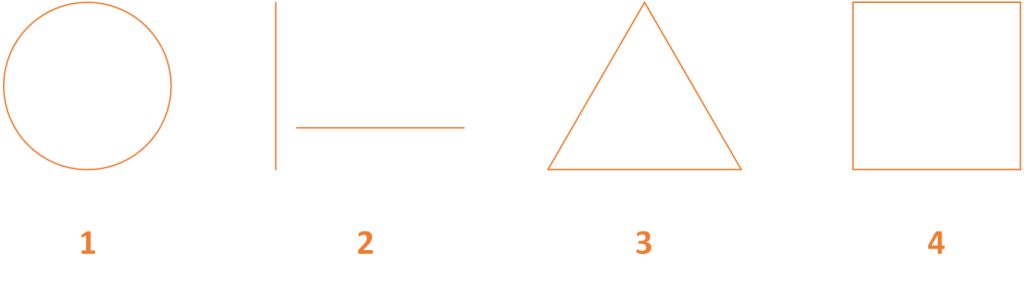
In Numerology and The Divine Triangle, the authors mentioned different esoteric geometries, including the above 4 shapes/lines, also symbolizing the numbers from 1 to 4:
Basic Esoteric Geometries

Regarding number 1 or the circle: “The Circle (1) represents the Godhead, all that was, is and ever shall be; spirit, the I Am; love because it encompasses, enfolds and contains; balance, because however you turn it, it maintains its shape; and justice, because it is in a state of perfect balance. A circle contains three hundred sixty degrees: 3 + 6 + 0 = 9. 9 is the highest and final digit in the series of single digits; when multiplied by another number, the result always reduces again to 9 (2 x 9 = 18 / 9, 3 x 9 = 27 / 9, 4 x 9 = 36 / 9 and so on). A circle has no beginning and no end; it is infinite and endless.”

Regarding number 2: This number is composed of two lines: one vertical and one horizontal. The vertical line symbolically represents “spirit descending into matter, or energy leaving the Godhead”. This line has masculine qualities: “it is outgoing, dynamic, energetic, fiery, upright and commanding.” The horizontal line, meanwhile, symbolizes the opposing energy to the vertical one. It represents ”the feminine, the receptive and absorptive qualities of mother earth. This line is an ancient symbol for matter and the material world.”

As with the number 3 or the triangle: “The triangle is the first closed form that can be made with single lines. It represents the Trinity, Father-Son-Holy Ghost, father-mother-God, father-mother-child, spirit-soul-mind, super-conscious, subconscious, conscious.”

And about the number 4 or the square: “The square is the second perfect shape that can be drawn with single lines; it is symbolic of the earth… the points on the compass; the four elements of fire, earth, air, and water…”, the four seasons, etc. The four sides of the square represent the four parts of the individual – with the physical body added to the triangle of mind, heart, and soul. The soul now has a mind and a heart to work in the material world.

The Divine Triangle and The Life’s Blueprint – Opening

In Numerology and The Divine Triangle, this triangle is called the triangle of mind, soul and spirit, but I would rather call it mind, heart and soul after I’ve done my data analysis. I will explain the reason in the following paragraphs.

Firstly, I’ve searched for the differences between soul and spirit in different sources and it seems that the distinctions can be quite varied across different philosophical, religious, and spiritual systems. I just mention here what resonates the most with me.

Speaking about soul, I choose to cite some words from Plato’s Theories of Soul. According to him, “the soul is most like, and most akin to, intelligible being, and that the body is most like perceptible and perishable being… the soul must be deathless – that is, immortal.” Socrates argues that the soul “is not visible and, in general, not perceptible, and that it shares its natural function with the divine, namely to rule and lead (the body in the one case, mortals in the other).” The soul, as Plato conceives of it, “is something that reasons, more or less well depending on the extent to which it is disturbed or distracted by the body and the senses; something that regulates and controls the body and its desires and affections, ‘especially if it is a wise soul’, presumably in a way that involves, and renders effective, judgments about what it is best to do, and how it is best to behave; and something that has, as the kind of adornment that is truly appropriate to it, virtues such as temperance, justice and courage.” “A good soul cares, rules, deliberates (etc.) and lives well, whereas a bad soul does these things badly.” (https://plato.stanford.edu)

With respect to spirit, there is much less information mentioning it clearly, but as explained in the Bible, we could understand that spirit is “your connection with God. It is the innermost part of your being, the center of you, the source of your identity.” (https://www.davidhernandezministries.com/)

Although there are distinctions between soul and spirit, and I also believe that it is necessary to indicate these differences, but as far as I know and have experienced, your spirit is actually the core part of your soul, your spirit is the centre of your soul just as your soul is the centre of your body. Since the spirit already lies in the soul, I would take the hypotenuse of the divine triangle as soul instead of spirit as mentioned in the book Numerology and The Divine Triangle.

As with the side of the triangle that represents soul, I replace it with heart, not just because of my experiences and observations through the years, but also on the basis of the following reasons:

  • Over thousands of years, ancient cultures like Mesopotamians, Egyptians, Babylonians, Chinese, and Greeks, shared a similar belief and knowledge about the heart as a source of intelligence and inner guidance. The heart, according to their belief, is capable of influencing and directing one’s emotions, morality, and decision-making ability. In the Tree of Life (Qabalah), which is presented as ten circles known as Sephiroth (spheres or emanations of the Divine), for example, we have Tiphereth (the 6th Sephirah) – the harmonizing centre of the Tree, embodying balance, the divine heart, and the union of mercy and severity – as the very centre of the Tree of Life (the centre of Equilibrium) and receives the powers of all other Sephiroth.
  • Modern science has also proved that our physical heart is an information processing centre that sends important signals to the brain and the rest of the body. It has the heart brain that talks to our head brain. “Our heart influences everything, from the way we feel to the way we interact with others, our brain function and our health”. (https://www.heartmath.org)
  • It would be a mistake if our Heart Chakra or the 4th Chakra is not mentioned when talking about the heart. In the popular system of 7 main chakras in our body that has been well known nowadays, Heart Chakra is the central point: “This is our spiritual center, our core, the place that unites forces from above and below, within and without. The task of chakra four is to integrate and balance the various aspects of our being.” “In entering the fourth chakra, we transcend ego in order to loosen our self-defined boundaries and merge into the ecstasy of love… Love and approval are basic to our personal growth, as the promote self-acceptance – a necessary step to loving oneself.” “More than anything, love is the deep sense of spiritual connection, the sense of being touched, moved, and inspired to heights beyond our normal limits.” (Wheels of Life – The Classic Guide to The Chakra System, Anodea Judith)

When we follow the path in the life’s Blueprint that is presented below, it should be reasonable that the three main stages of growth in a person’s life would start from mind, to heart, and then soul, taking turns being the prevailing decision maker.

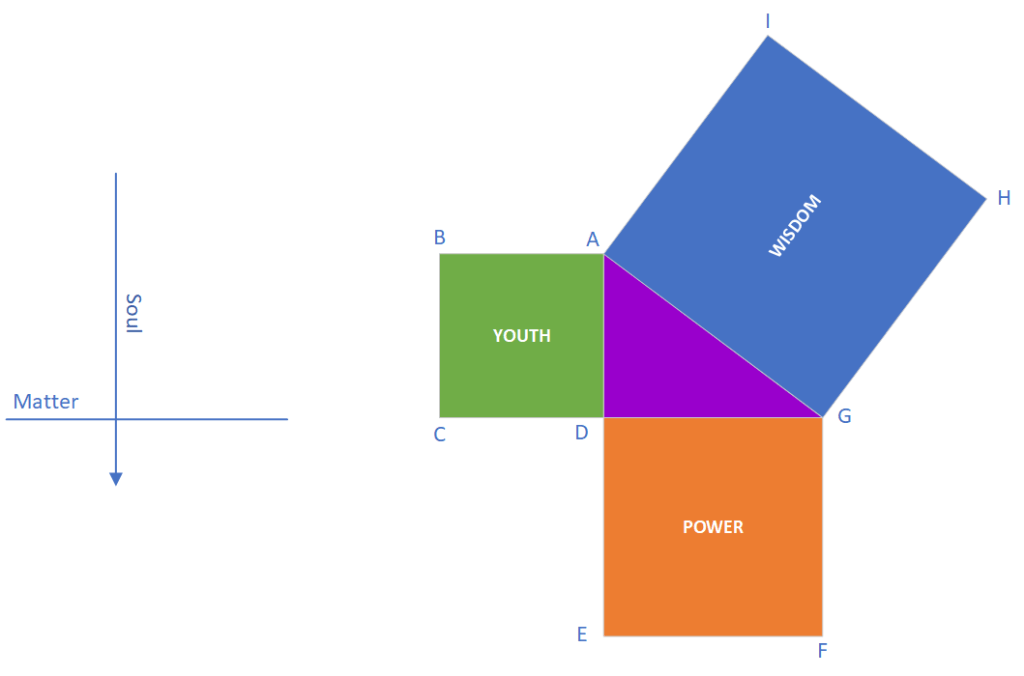
The above mentioning of basic esoteric geometrical forms is the introduction of the so-called Blueprint of each person’s life, which is the delineation of the Divine Triangle ADG (based on Pythagorean Theorem, which states “The square of the hypotenuse of a right triangle is equal to the sum of the squares of the other two sides.”)
Divine Triangle and The Life Blueprint

As in the above illustration, the cross is also part of the Divine Triangle, where “spirit descends into matter” and “we as human beings are stationed at the corner point where the two lines of the cross meet… we are the recipients of the cosmic energy; therefore, these points represent an aspect of consciousness.”

I agree with the book Numerology and The Divine Triangle that the soul enters the body at point A and moves through each path from A to I in sequence, but since each person has their own speed, the time for each one to finish one path should never be the same as in the book (which is 9 years for each path); rather, time for each person to go through a path should be different, and the time for this same person to finish each of their different paths could be different as well. Life has cycles, and the cycles for each person are not necessary the same; besides, as one is the main decision maker of his/her own life, one can totally choose how to react and behave in one’s own cycles, which may alter the length of the cycles.

I take the name of the three squares of the Blueprint as they are in the book – Youth Square, Power Square, and Wisdom Square – but I will explain them in details in my way in the next article.

Sources:

  1. Anodea Judith PhD, ‘Wheels of Life – The Classic Guide to The Chakra System’, Llewellyn Publications – Woodbury, Minnesota – Second Edition, 2019.
  2. Chic Cicero & Sandra Tabatha Cicero, ‘Golden Dawn Ritual Tarot – Keys to the Rituals, Symbolism, Magic & Divination’, Llewellyn Publications – Woodbury, Minnesota – Second Edition, 2020.
  3. Faith Javane and Dusty Bunker, ‘Numerology and The Divine Triangle’, Whitford Press, U.S., 1997.
  4. Hans Decoz with Tom Monte, ‘Numerology – The Key to Your Inner Self’, TarcherPerigee, 2002.
  5. Heather Alicia Lagan, ‘Chaldean Numerology For Beginners – How Your Name & Birthday Reveal Your True Nature & Life Path’, Llewellyn Publications – Woodbury, Minnesota, 2020.
  6. https://plato.stanford.edu/entries/ancient-soul/#3
  7. https://www.davidhernandezministries.com/blogarchive/2021/7/16/body-soul-spirit-simply-explained
  8. https://www.heartmath.org/
  9. https://www.meaningfullife.com/your-soul-map-the-tree-of-life/

The Four Natural Evolutionary States of The Consciousness of The Soul

  1. The Dimly Evolved State
  2. The Consensus State
    1. 1st Subdivision of the Consensus State
    2. 2nd Subdivision of the Consensus State
    3. 3rd Subdivision of the Consensus State
  3. The Individuated State
    1. 1st Subdivision of the Individuated State
    2. 2nd Subdivision of the Individuated State
    3. 3rd Subdivision of the Individuated State
  4. The Spiritual State
    1. 1st Subdivision of the Spiritual State
    2. 2nd Subdivision of the Spiritual State
    3. 3rd Subdivision of the Spiritual State

Several years ago, as I started my interest on spirituality, the first subject I felt attempted to learn was astrology. Then I began to read about souls, which raised many questions in me as a person working in the IT industry and almost always putting logic in the first place. Of course, I had to undergo quite many not-so-comfortable experiences in order that I gradually accepted what I read about souls, but still, I didn’t accept much of what I have read.

One day, I kept lying in bed and thinking: “Is there some connection between astrology and soul? Could we figure out something about our soul from some tool in astrology? There should be! But how to find it?” So, I took my computer and googled for a while, nothing I found really satisfied me until the term “Evolutionary Astrology” caught my eye. That’s how I came to know Jeffrey Wolf Green – the founder of the School of Evolutionary Astrology – and his works. Reading his books really opened for me a whole new way of approaching and understanding astrology. But that’s not the purpose of this article.

Today I want to give you a summary of what Green wrote about the Consciousness of the Soul and its Four Natural Evolutionary States, which I find very interesting and which has triggered in me even more curiosity to study more and more about spirituality.

According to Green, each human form with a Soul in it is an individualized Soul with its own consciousness and intelligence and such consciousness “can be fully consciousness or it can be minimally conscious” depending on the degree of its evolution. It is critical from an evolutionary astrology point of view to know this because many Souls have the same or similar birth charts, yet the degree of evolution of one Soul will determine how conscious it is of itself as well as of the Source – where it comes from.

Green referred to the “Natural Triad of Consciousness” as the combination of three planets in every birth chart: The Moon as our Ego, Pluto as our Soul, and Neptune as our individualized Consciousness relative to the Collective Consciousness of all humans. The simile of the Moon as our Ego does not sound so reasonable enough for me, maybe it is just because of the way I understand Ego, but I think it will take time until I can either really get this idea, or figure out something else which is for me more appropriate.

Concerning the Soul’s evolution, Green splits it into four “natural” states or conditions, or stages: (1) The ‘Dimly Evolved’ State with roughly three or four percent of all Souls, (2) The ‘Consensus’ State with about seventy percent of all Souls, (3) The ‘Individuated’ State with about twenty percent of all Souls, and (4) The ‘Spiritual’ State comprising roughly four to six percent of all Souls on the planet.

Below I will summarize what has been written by Green about these four states. There are a few things I do not quite resonate with, so I try to omit some of them (but not all, for the sake of the logic behind this text). If you want to read the whole content, you should read the book, which I put at the end of this article.

The Dimly Evolved State

Souls that are in the beginning of human consciousness are characterized by a very limited sense of self-awareness. These Souls are typically very joyous, very innocent, and can bring great love to those who are close to them. However, these Souls are also assumed to be characterized by some terms like cretinism, very low IQ’s, mongolism, mental retardation, and the like. Souls that are de-evolved can also have the above conditions due to karmic causes and thus, experience great and humiliating limitations and some of them can even go about creating great disturbances for other people.

The Consensus State

This state correlates astrologically to Saturn, because of the underlying desire to conform to the consensus of any society, culture, tribe, or country. There are three subdivisions within the consensus state, each one reflects the ongoing evolution of a Soul through the entire evolutionary state. The root desire that propels the evolution of the Soul forward within this consensus state from the first subdivision through the third is characterized by the desire to ‘get ahead of the system’, or get ahead of the consensus society that they belong to.

1st Subdivision of the Consensus State

Souls within the first subdivision of the consensus state are characterized by a limited sense of self-awareness, essentially limited to the time and space that they occupy; and yet they are incredibly self-righteous relative to the values, moralities, consensus religion of the existing society of birth, how life is interpreted according to those beliefs, the judgments issued because of those beliefs, etc. There is no ability to separate themselves from any of this.

2nd Subdivision of the Consensus State

The reality for the Souls within the second subdivision of the consensus state is still totally defined by the consensus of society like in the first subdivision; yet by desiring to get ahead, the Soul must expand its personal awareness of the nature of the dynamics of how the society it is a part of is put together. The Soul thus becomes more aware of ‘others’, of its surrounding community, of the country it lives in, as well as some differences between their societies and other societies in terms of values, moralities, religions, etc.

3rd Subdivision of the Consensus State

Within the third subdivision of the consensus state, the Soul’s personal awareness has now expanded to the point of being aware of the totality of the community and society that it belongs to, and of the country that it lives within as well as a progressive awareness of other countries, cultures, and of the relativity of moralities, values, religions, etc. However, within this subdivision, the self-righteousness born out of conformity is still sustained: ‘we are right, and they are wrong’, which makes the consensus state correlate to what is called ‘nationalism’.

The Individuated State

The individuated state correlates astrologically to Uranus, because the Soul now desires to liberate or rebel against the consensus state from which it is now evolving away from. Souls in this evolutionary state inwardly feel ‘different’ from the majority of the society and country of birth. The Souls now begin to question the assumptions that most people hold dear to their heart that correlate to what ‘reality’ is and is not.

Through independent thinking and investigating all kinds of different ways of understanding life, including ideas, beliefs, and philosophies from other lands and cultures, the Souls’ consciousness and personal awareness will be increasingly expanded.

1st Subdivision of the Individuated State

In this subdivision, the Soul will typically try to ‘compensate’ for its inner feeling of being different from the consensus by trying to appear ‘normal’. This compensation manifests because, after all, the consensus is where the Soul has just been and thus, constitutes a sense of security, as opposed to the inner feeling of being detached and different.

The Soul will nonetheless be questioning everything deep within themselves and progressively distance itself from the consensus and begin to form relationships with other alienated Souls just like itself.

2nd Subdivision of the Individuated State

The second subdivision of the individuated state is where the underlying archetype of Uranus as it correlates to rebellion is at its highest. The rebellion is so extreme that the Soul has now ‘thrown off’ almost any idea or philosophy that has come before, at any level of reality.

The Souls tend to exhibit a deep fear of integrating into society in any way and therefore, usually hang out in the edge of the society so as to reinforce their sense of personal righteousness which is defined by their alienation from the consensus. This will continue until some point of time when they realize that their fear of integrating into reality or society is nothing more than a fear and hence, begin to make the effort to integrate back into society, but with their individuality intact.

3rd Subdivision of the Individuated State

In this third subdivision, the Soul begins to manifest within society or reality as a truly unique and gifted person, from the viewpoint of the consensus. The Souls at this point learn to integrate their unique gift or capacity within the consensus to help the consensus evolve as well – they are now aware of the entire world and the relativity of beliefs, values, moralities, etc.

The Spiritual State

The spiritual state correlates astrologically to Neptune because now the root desire becomes to consciously know, not just believe in, but “to know and unite with the Source of All Things”. Progressively in this state, the very centre of gravity within the Soul’s consciousness shifts from the subjective ego to the Soul itself.

1st Subdivision of the Spiritual State

The Soul progressively becomes aware of just how small it is as compared with the increasing universal dimensions that are occurring within its consciousness, which is exactly the naturally humbling archetype that allows the centre of gravity to gradually shift within the Soul’s consciousness from the subjective ego to the Soul itself.

The Soul begins gradually to commit itself to the desire to reunite with the Source through different spiritual practices or various forms of work that all correlate to being of service to the larger whole in some way.

In the first subdivision, the Soul becomes progressively aware of all that it needs to improve upon within itself: it is now aware of all its imperfections and therefore can become highly self-critical and feel that they are not good enough or not yet ready to do the task that it is being inwardly directed to do.

2nd Subdivision of the Spiritual State

In this subdivision, the shift in the centre of gravity within consciousness tends to manifest like a rubber band, wherein the gravity point keeps going back and forth from the subjective ego to the Soul.

The problem that may generate within this subdivision is that the subjective ego can be fuelled in such a way that the Soul feels more evolved that it actually is, which will lead to various degrees of ‘spiritual delusions of grandeur’ from an egocentric and Soul point of view. This is one among different kinds of egocentric impurity remaining within the Soul that must be purged. As the Soul evolves through this subdivision, it finally realizes the nature of this root impurity, experienced as a guilt, and will create its own downfall to atone for that guilt.

3rd Subdivision of the Spiritual State

In the final subdivision of the spiritual state, the Soul is finally and firmly identified with that which has created it: The Source of All Things. The elimination of any remaining separating desires within the Soul will be the main focus in this final subdivision.

Now the Soul inwardly feels and knows that it is here to do some kind of work on behalf of the Source; the consciousness of the Soul is entirely structured to give to others, and to give purely without any ulterior agenda or motive involved. Such Souls are naturally humble and have no desire whatsoever for any kind of acclaim to their ego.

The above way of classification of Soul’s evolution stages is of course only one among different methods that I know (or not know). But the thing is, whatever the method one uses, one cannot determine which evolutionary condition exists for any Soul by simply looking at the astrological birth chart alone. Usually, observation and interaction with the interested person would be necessary for such determination to be made.

Sources:

  1. Jeffrey Wolf Green, ‘Neptune: Whispers From Eternity’, School of Evolutionary Astrology, 2014.

Soul as the Quality of Divinity (Seven Rays of Soul)

  1. Ray 1: The Ray of Will and Purpose
  2. Ray 2: The Ray of Love and Wisdom
  3. Ray 3: The Ray of Active Intelligence and Adaptability
  4. Ray 4: The Ray of Harmonization (Harmony through Conflict)
  5. Ray 5: The Ray of Science and Concrete Knowledge
  6. Ray 6: The Ray of Idealism and Devotion
  7. Ray 7: The Ray of Ceremonial Order and Magic

From the esoteric view of life, every human being is destined to become a spiritual magician. The soul evolves over vast periods of time with the goal of creatively expressing itself through a cooperative personality. By so doing the soul influences the outer world through its power to magically uplift. This is the core purpose behind human evolution, and is the clue to the hidden yearnings of the soul.

The individualized human soul incrementally develops its capacity to manifest itself during each incarnation through its lower reflection, the ego (or personality) with the goal of fully radiating its nature through the personality without distortion.

It is important to know that the human personality is triple in nature, being composed of mental, emotional and physical attributes. Esoterically, these aspects of the lower self are considered vehicles of outward expression to be used by the soul.

Within the human energy system, the soul is the creator; but from the larger perspective, the soul is acting as a creative agent on behalf of Divinity. The personality of the soul is intended to be an embodiment of love, applied with intelligence and want to express that loving intelligence through the personality. Since the soul itself resides upon the plane of abstract mind, it needs a ‘vehicle’ in order to have influence within the realms of normal human experience. As mentioned above, because an aspect of the personality is composed of mental substance, the soul can utilize this aspect when seeking to influence the outer world of thought. Similarly, when the soul needs to make emotional contact with the environment, it does so via the emotional body contained within the personality. Finally, the soul utilizes the physical body as a conduit for expressing itself in terms of outer physical activity.

Though all souls are inherently conditioned by love, beyond this important commonality, significant variations exist. In the Esoteric Tradition, it is understood that there are seven types of souls, each of which represents an essential quality of the Divine seeking manifestation through the human kingdom. Each soul, by its nature, accents an aspect (quality) of the Divine, and as such, is destined to reveal that quality in the outer world.

Just as white light divides itself into seven colours, so too does the Divine Light express itself in seven unique qualities, referred to as the Seven Rays in the ancient Esoteric Philosophy. Most importantly, every human soul is an expression of one of these Seven Rays in which each ray acts like a lens that look out at life, each ray is a patterning process of consciousness, and every soul is uniquely one of those seven patterns of how to perceive the world, how to see the oneness of humanity, and how to respond to or serve from that perception. However, these rays or soul types are not in the world in equal proportion. The amount of each soul type at any time is assumed to be decided by the situation of that time as well as the next need of the humanity.

One thing to be noted here is that we are talking from a soul’s perspective. Besides the soul ray, each person also has a personality ray, and that ray is going to be one of the Seven Rays too. In other words, your soul ray is with you every incarnation, but that soul will manifest an outer garment called ‘personality’ in each incarnation; that personality ray will also be one of Seven Rays, but not necessary the same as the soul ray. Although normally the personality tends to think it is an independent agent, but actually it is only an appendage; and it is not the goal of the universe to ‘kill’ the personality, but to slowly condition it to understand its true role. Furthermore, each one also has a ray that animates one’s mental body, a ray that animates one’s emotional body, and a ray that animates one’s physical body. But it is not in the scope of this text to go further into these.

Below I will give some short understandings about the Seven Rays:

Ray 1: The Ray of Will and Purpose

The intention of this type of soul is to reveal the Purpose of Divinity within the human kingdom, it is its objective to supply the power and direction to the evolutionary movement of life. The First Ray is deeply associated with death and rebirth, since its role is to shatter those forms that no longer adequately express the Divine Love; it frees life from its encasement within outworn forms, thereby allowing it to seek new and higher forms through which to express itself more radiantly.

There are currently many souls found upon this ray. These souls are uniquely sensitive to the larger spiritual principles seeking to evolve through human society and environmental circumstance. Leadership comes naturally to this type of soul, for they see what must come to be and will naturally assert power on its behalf. Societally, the First Ray animates and vitalizes the institutions of politics, government, and international statesmanship.

Archetypally this ray is similar to the sign of Aries, and actually Aries is also a first ray sign – the first sign of the Zodiac, the sign that initiates. Although it is naturally for all rays to be inclined to push new ideas forward by gathering enough will to overcome the inertia largely governing humanity, it is in the First Ray that has the strongest push energy since it is will and it is power.

Ray 2: The Ray of Love and Wisdom

The Second Ray is the ray that conditions life with Divine Love with the role of revealing the unity that underlies all apparent diversity within creation. Love, expressed through compassion and understanding, is how this ray manifests for those whose souls are conditioned by it. People with Second Ray soul tend to commit their lives to promote love and wisdom in all that they see and do with the acknowledgement that wisdom is a form of love, demonstrating itself through understanding and tolerance.

From the larger perspective, this ray governs the educational and counselling efforts found within all human societies, as well as the healing arts – whether traditional or alternative in nature.

This soul type has a large incarnational presence at this time because humanity is in transition from the Piscean to the Aquarian Age, and people with Second Ray souls are able to skilfully disseminate the new and emerging ideas that will shape human society during the Aquarian era to come. In a way, the Second Ray is a building ray, building ray in the sense that while the First Ray destroys the old, the Second Ray may show the ideas to build something new, as well as heal, educate, or support people in the developing process.

Ray 3: The Ray of Active Intelligence and Adaptability

The Third Ray is the energy most related to Divine Intelligence since it provides the underlying knowingness in all of nature. It is the force that animates human thought, revealing the Divine Mind within the consciousness of humanity and giving spiritual understanding to all human activity.

People with Third Ray souls are committed to finding ways to adapt new knowledge into designs that have functional value. Their minds are often inclined towards systems thinking, thereby giving them the ability to see the interconnectedness of things and to figure out a way to adapt. The knowledge, once being applied correctly, will bring forth wisdom, and wisdom must be eventually synthesized into omniscience.

The Third Ray is a very higher mind kind of ray. It is a consciousness that tends to want to always connect things because it knows the truth that everything is connected to everything else, everything affects everything else, everything is within a system, and the changing of one thing will inevitably lead to the change of many other things.  

The Third Ray governs philosophy and, maybe to your surprise, business as well. Because whether the business person or the philosopher, the underlying will to ‘manipulate’ is really important, ‘manipulate’ not in a negative sense, but ‘manipulate’ as in the examples of the philosopher manipulating ideas in order to arrive at a new truth, or the business person manipulating resources in order to achieve a desired and profitable end.

Ray 4: The Ray of Harmonization (Harmony through Conflict)

The Fourth Ray is the force that creates a sense of equilibrium and beauty within creation. People upon the Fourth Ray tend to immediately see both sides of opposing perspectives and will persistently search for the means to harmonize them. Some examples of these opposing perspectives can be peace and war, happiness and sadness, light and darkness, etc. These are just some of the endless array of dualities manifested everywhere in our lives that, for each pair, one will become a meaningless concept without the other.

Fourth Ray souls deeply recognize that humanity is struggling to evolve toward a higher and more peaceful state of being. The major task of this type of soul is to bridge new ideas with the old, and by so doing mitigate the tendency for conflict to emerge between them. This is the most intuitive of the Ray types, and it is through this faculty that spiritual harmony can be realized. Intuition is always rooted in higher harmony and is the key to finding one’s destiny and although all the rays are very much related to intuition, none are related more than the fourth ray.

People that have a strong Fourth Ray tendency personality or Fourth Ray soul would be inclined to have a remarkable sensitivity. It is also the ray most associated with art and beauty; most artists will have strong Fourth Ray, either in their personality nature or their mental bodies, some in their emotional bodies too. It is mentioned in the Esoteric Philosophy that this particular soul type does not exist today but will begin to incarnate in 2025, hence the first wave of those hitting adulthood will be about in the middle of the century.

The institutions that the Fourth Ray rules include all kinds of arts and culture, and it rules the United Nations as well. The United Nations is the manifestation of a fourth ray vibration with the mandate to reconcile international differences through peaceful means and to honour cultural diversity in the process. Even though the United Nations is now still in its infancy and therefore making a lot of mistakes along the way, its destiny will be more profound as we move further into this century.

Ray 5: The Ray of Science and Concrete Knowledge

The Fifth Ray is the energy that reveals the Clarity of Divinity through the pursuit of correct knowledge. While the Third Ray gives to humanity the ability to use the mind with creative adaptability and to deepen our understanding of reality through the connecting of ideas, the Fifth Ray disciplines the adaptable mind, so that the distinction between truth and fiction or falsity can be more clearly discerned.

Those upon the Fifth Ray tend to be dedicated to finding solutions (truth) to the many problems facing humanity with the spiritual purpose of demonstrating that the function of knowledge is to reveal the spiritual essence behind all forms within creation.

From a societal perspective, science is the manifestation of the Fifth Ray. Science is completely dedicated to the precise examination of reality and advances in medicine, physics and chemistry all give testament to the transformative power of this ray.

Fifth Ray is the ray that is the single most important vibration behind the whole sign of Aquarius. And because we are entering into the Age of Aquarius, the Fifth Ray is also going to be increasing its presence. Before we used to see science applied to engineering, building locomotives, industrialization, etc.; nowadays, however, science is moving into subtle patterns, quantum fields, string theory, and so on. That is exactly what would be anticipated as this ashram continues to mature in its relationship to humanity’s welfare.

Ray 6: The Ray of Idealism and Devotion

The purpose of this ray is to bestow the Vision of Divinity within consciousness. As the sacred energy of devotion, it instils within us a willingness to dedicate our lives to something transcendent to ourselves. Sixth Ray people are destined to reveal to humanity that a heart devoted to an ideal has the power to transform life, individually and collectively considered.

People whose souls reside upon the Sixth Ray are moved to devote their lives in support of the ideals they inwardly sense. This energy eventually leads one to realize that the path to enlightenment is found through the renunciation of desire because human desires are recognized as anchors that prevent us from inward and upward ascent.

Sixth Ray is a very strong love ray, like the Second Ray. But there is a difference: while Second Ray souls’ inner call is the loving unity of humanity and they feel the love very wide and diffuse, the Sixth Ray souls also feel that energy, but then they take that quality of love that is being felt and focus it to the extent that it becomes the love of the ideal, the love of devotion.

This ray is the energy that animates theology and religions around the world, and it also governs all social welfare movements. In addition, the Sixth Ray characterizes the worthy causes for which people passionately fight, such as environment protection, hunger amelioration, or human rights trumpeting.

The Sixth Ray souls, this ashram is believed to be currently pulling back and will continue to withdraw for some time to come. We can see that many religions around the world are being in big crisis with either more and more people moving away from their religions or more and more distortions of religions are being manifested.

Ray 7: The Ray of Ceremonial Order and Magic

The Seventh Ray is best known for bringing order out of chaos since its purpose is to provide the energy needed to translate spiritual ideas into tangible effects. Through the influence of this ray, the Manifestation of Divinity is made possible. Seventh Ray individuals believe that the purpose of life is to bring spiritual love and wisdom into practical expression.

Seventh Ray people are inclined to view things in practical terms. Their organizational abilities are normally quite good, which is one of the reasons that they are able to manifest what they intend. They are frequently attracted to business, politics or educational environment; some may work in the arts, particularly when the elements of ceremony or ritual are involved.

This ray is also called The Ray of Organization, since it seeks to give good form to societal structures and institutions. It is the Seventh Ray that teaches us to build thoughts that are efficient in their design, while remaining true to the archetypes they represent. Seventh Ray people tend to be dedicated to building structures, mental and/or physical, that can efficiently serve the cause of human betterment.


One may notice that the characteristics of any given ray find closer correspondence with one of the other rays than with the rest. This is a fact. The only one which stands alone and has no close relationship with any of the others is the Fourth Ray. This brings to mind the unique position which the number four occupies in the evolutionary process. Esoterically, four is the number of stability, the symbol of law, system and order. It is firmness, stability and conservatism. With 4 ions, the inevitable concentration of energies occurs and the ions can no longer scatter their energies but must begin to place them in a productive, orderly system.

As with other rays: Between the Third and the Fifth Rays there is a close relationship. In the search after knowledge, for example, the most laborious and minute study of detail is the path that will be followed,
whether in philosophy, the higher mathematics or in the pursuit of practical science. The correspondence between the Second and the Sixth Rays shows itself in the intuitive grasp of synthesized knowledge, and in the common bond of faithfulness and loyalty. Last but not least, masterfulness, steadfastness, and perseverance are the corresponding characteristics of the First and the Seventh Rays.

To end this article, I would like to cite “The Seven Keys to The Seven Ray Methods” from the great work of Alice A. Bailey:

FIRST RAY
“Let the Forces come together. Let them mount to the High Place, and from that lofty eminence let the Soul look upon a world destroyed. Then let the word go forth: ‘I will persist’.”

SECOND RAY
“Let all the life be drawn to the Centre, and enter thus into the Heart of Love Divine. Then from that point of sentient Life, let the Soul realise the consciousness of God. Let the word go forth, reverberating through the silence: ‘Naught is but Me!’,

THIRD RAY
“Let the Army of the Lord, responsive to the word, cease their activities. Let knowledge end in wisdom. Let the point vibrating become the point quiescent, and all lines gather into One. Let the Soul realise the One in many, and let the word go forth in perfect understanding: ‘I am the Worker and the Work, The One that Is: ‘ “

FOURTH RAY
“Let the outer glory pass away and the beauty of the inner Light reveal the One. Let dissonance give place to harmony, and from the centre of the hidden Light let the soul speak, let the word roll forth: ‘Beauty and glory veil Me not. I stand revealed. I Am.

FIFTH RAY
“Let the three forms of energy electric pass upward to the Place of Power. Let the forces of the head and heart and all the nether aspects blend. Then let the Soul look out upon the inner world of light divine. Let the word triumphant go forth: ‘I mastered energy for I am energy itself. The Master and the mastered are but One.’

SIXTH RAY
“Let all desire cease. Let aspiration end. The search is over. Let the Soul realise that it has reached the goal, and from that gateway to eternal Life and cosmic Peace let the word sound: ‘I am the seeker and the sought. I rest.'”

SEVENTH RAY
“Let the builders cease their work. The Temple is completed. Let the Soul enter into its heritage and from the Holy Place command all work to end. Then in the silence subsequent let him chant forth the word: `The creative work is over. I, the Creator, Am. Naught else remains but Me.'”

Sources:

  1. Alice A. Bailey, ‘A Treatise on The Seven Rays’, Lucis Trust, 1990.
  2. Faith Javane and Dusty Bunker, ‘Numerology and The Divine Triangle’, Schiffer Publishing Ltd., 1979.
  3. William A. Meader, ‘Shine Forth – The Soul’s Magical Destiny’, Source Publication, 2004.
  4. https://meader.org/

Personal Transformation in Astrology

  1. Sun and Moon Principles
  2. Uranus, Neptune, and Pluto
  3. Aspects of Transformation in the Natal Chart
  4. Astrological Elements & Personal Transformation

Once we see reincarnation and Karma (see Karma – What is it?) as facts of life and then dedicate ourselves to self-transformation based upon a spiritual ideal, once we accept that there is a reality higher than what our physical senses perceive, it becomes apparent that most important solutions come not from the outer world, but from within. As the Swiss psychiatrist and psychoanalyst Carl Jung has pointed out many times in his writings, that with which you are not consciously in touch happens to you as fate, the more one is consciously in touch with one’s inner life, the more astrology can support you as “a means of clarifying the stages of self-development which we should welcome and use as opportunities for personal transformation” (Stephen Arroyo).

According to Arroyo, all of astrology deals with transformation when applied to individuals’ lives. Specifically, he mentions different kinds of personal transformation based on considering the planetary configuration as follows:

  • SUN: Transformation of the identity and mode of creative energy expression.
  • MOON: Transformation of one’s feelings about oneself and how comfortable one is with oneself.
  • MERCURY: Transformation of one’s mode of thinking & perception, and of the way in which one expresses one’s intelligence.
  • VENUS: Transformation of one’s emotional values and mode of expressing and understanding one’s needs for closeness.
  • MARS: Transformation of the capacity to assert one’s will and to know what one really wants.
  • JUPITER: Transformation of one’s beliefs, aspirations, and long-term plans for the future – all of which promise some kind of improvement.
  • SATURN: Transformation of one’s ambitions, priorities, and work structure.
  • URANUS: Transformation of one’s sense of freedom, individual purpose, and personal uniqueness.
  • NEPTUNE: Transformation of one’s spiritual and/or social ideals.
  • PLUTO: Transformation of the use of one’s inner powers and resources, particularly the mind and will power.

In order to experience these transformations in a healthy and relatively harmonious way, one must have the right attitude toward and relationship with the various energies and powers that the planets represent.

Sun and Moon Principles

In the two Indian scriptures, the Vedas and the Shastras, it is written that individual souls come down from the astral regions to this material world along the rays of the Sun and Moon. But when the soul incarnates into the realms of duality, it seems that the soul polarizes according to the Sun and Moon positions. In other words, it is reflected into two aspects of being, manifesting as conscious and unconscious, active and passive, male and female – it is the Sun and Moon principle.

Although the scientific world-view describes the Sun as immensely larger than the Moon, when seen from the earth, both appear to be the same size; hence, symbolically, the lunar and solar forces in our lives are of absolutely equal importance.

The Sun and Moon positions in the natal chart also reflect our experience of the parents and our relationship to them. The Sun and Moon positions and especially their aspects usually symbolize one’s inner experience of the parents, what the parents as a couple represented to the person. But we should be clear about the fact that the birth chart primarily shows our experience, not necessarily the ‘objective’ facts of the situation.

Uranus, Neptune, and Pluto

Through the “influence” of these three transcendent forces, a human being experiences great changes in his thought patterns, level of consciousness, lifestyle, and capacity for self-expression. The trans-Saturnian planets most immediately influence the deepest psychic life of the individual, and a more aware person is capable of being a channel for the expression of the purest, most refined, and most constructive manifestations of these forces.

The trans-Saturnians, as observed from the Earth, move slowly; therefore, each remains in one sign of the zodiac for many years. Thus, we find entire generations of men and women experiencing generally similar changes, although the specific focus of the changes differs from person to person, according to the house positions and aspects with other planets.

We can see in chart comparisons how the cosmic evolutionary forces operate through each individual, coming to a specific focus in the relationship of one person to another. The perennial ‘generation gap’ is a good example of how the trans-Saturnian planets correspond with the experience of pressure toward growth and more inclusive consciousness. Encountering people of different generations, therefore, can be more difficult than relating to our peers. Such relationships necessitate that we grow in order to become more inclusive.

The basic personal factors in any individual’s life are always the same and motivate distinct orientations in an individual’s conscious life. Astrologically, these forces are symbolized by the Sun, Moon, Mercury, Venus, and Mars. Jupiter and Saturn constitute an intermediary step between the personal planets and the transpersonal, impersonal forces of the trans-Saturnians, since they so often have to do with our participation in society and with socially-coloured norms, beliefs, and ambitions. The factors symbolized by these seven planets are, to some extent, modifiable through conscious experience and by the concentrated use of the will. Uranus, Neptune, and Pluto, on the other hand, are totally beyond conscious control, but a person can control his attitude toward their influence in his life. He can modify his conscious orientation toward the manifestations of these greater forces. In terms of their function, Uranus, Neptune, and Pluto always prompt change in the area of life affected. Willpower and determination alone are never enough to cope with these energies.

In addition to the natal house positions and aspects, the transits of Uranus, Neptune, and Pluto are also highly significant. Transits of these planets over sensitive points in the natal chart are the most penetrating and far reaching of all transits; and their ultimate effects are the most comprehensive and long lasting. None of the three alone can be called the planet of ‘intuition’ or psychic power since they deal with higher planes of being with the following differentiation:

  • Uranus represents mental understanding of higher levels, levels of consciousness where dualities are united in the living truth.
  • Neptune represents an emotional attunement to higher levels, a yearning for and infatuation with higher planes of being.
  • Pluto represents a commitment to act upon our needs for transformation, to incorporate the higher levels of consciousness into our very being, knowing that all desires and attachments will have to be brought to the surface and purged and that all our true motives will have to be faced.

Aspects of Transformation in the Natal Chart

Arroyo’s favourite law of aspect is that:

“The planets in the signs represent the basic urges toward expression and needs for fulfilment, but the aspects veal the actual state of the energy flow and how much personal effort is needed in order to express a particular urge or to fulfil a particular need.”

Stephen Arroyo

One option to classify aspects is to divide them into two groups: dynamic or challenging aspects, and harmonious or flowing aspects. The harmonious aspects show that the two energies (or the two dimensions of the individual’s being) involved vibrate in harmony and reinforce each other within the person’s energy field. In other words, the harmonious aspects indicate a state of being and attunement that is inwardly stable and strong, the energy can flow rather easily; but this does not mean that the energies cannot be misused in a given person or situation. The challenging aspects show that the energies involved do not vibrate in harmony, but rather tend to interfere with each other’s expression and to create stress. This irritation or instability can, however, prompt the individual toward some sort of definite action in order to resolve the tension. The reason is that, when the stress reaches its peak, even more energy is released, and this additional energy can be consciously directed toward some constructive goal, or it can simply explode and cause problems in the individual’s life.

Planets involved in the challenging aspects give us an insight into what sort of karma we should deal with in this lifetime, because it often seems that a planet in a challenging aspect reflects a previous misuse of that particular energy in the past and the negative habit carries over into the present.

Here is how Arroyo summarizes the types of attachments indicated in challenging aspects with planets in our natal chart:

  • SUN: too much attachment to being someone special.
  • MOON: too much attachment to the past, to family and racial background, and to earthly peace (in the sense of expecting the outer world to be perfect).
  • MERCURY: too much attachment to intellect and mental pride.
  • VENUS: too much attachment to physical comfort, emotional satisfaction, and to other people in general.
  • MARS: too much attachment to action, achievement, winning over another person, and attainment of one’s own desires.
  • JUPITER: too much attachment to doing things in a big way (and thus a lack of humility).
  • SATURN: too much attachment to social approval, power, authority, and reputation.

Astrological Elements & Personal Transformation

The elements have traditionally been divided into two groups: fire and are being consider active and self-expressive, and water and earth considered passive, receptive, and self-repressive. Marc Edmund Jones, being called the dean of American astrology, has written that air and fire are “manipulative and extensional” expressions of energy, whereas earth and water are “sustaining and intensive.” This classification of elements carries the fact that the signs of the same element and of the elements in the same group are considered to be generally more compatible than elements of different groups.

The four elements are particularly useful in understanding the essential nature of any individual’s psychological makeup. Every individual is composed of all four elements but in various proportions. Elements that are lacking emphasis in the natal chart would indicate specific realms of life activity with which one is not consciously in contact, and hence an attunement regarding these elements must be consciously cultivated and developed in order for the individual to be able to participate in that field of experience required for a full and well-rounded life. Likewise, those who have an over-emphasis on a particular element in the natal chart tend to over-value that realm of experience, to the detriment of their potential for wholeness.

  • Imbalance of fire: If one has too little emphasis in the fire signs, the fiery energy is lacking and the digestion is likely to be weak; there are tendencies to be lack of spiritedness, not to trust life itself, to be devoid of faith and optimism, to be scared of challenges, etc. On the other hand, too much emphasis on fire means the individual tends to be overly active, restless, and overly concerned with making something happen in the world. They also tend to have problems dealing with others due to their impulsiveness, self-centredness, and unrestrained desire to act directly at all costs.
  • Imbalance of earth: Those having too little emphasis on the earth element are not naturally attuned to the physical world, the physical body, or to the limitations and requirements of survival in the material plane. They often feel like they don’t fit into any niche in society’s structure, and often has trouble finding a life’s work that is satisfying. However, this lack of earth can have some very beneficial effects, for the person accepts no limitation to what is possible, either spiritually or in his creative efforts, which, together with time, may lead to fruitful results, but only if the individual has at least learned to accept the basic requirements of earthly living. Those with too great an emphasis on the earth element, on the other hand, tend to rely too much on things as they appear to be. There can be a narrowness of vision, and/or an obsessive concern with what works rather than with what ideals one should shoot for, and often a considerable lack of imagination. Naturally, these people will exemplify a remarkable strength and efficiency in most cases, and they need to channel their energy into a specific work that challenges them. However, the world of work and practical affairs often tends to dominate their entire lives and they also tend to possess cynicism and scepticism qualities if they have no ideal or inspiration to infuse life with significance.
  • Imbalance of air: Those with too little emphasis on the air element in their natal charts are normally too involved in action, feelings, and material concerns to consider the implications of their involvements. It is the lack of perception, together with the inability to reflect on life and themselves that will create problems for these people. They often find themselves burdened by involvements that were not sufficiently considered beforehand or by a lack of satisfaction in close relationships stemming from their inability to cooperate effectively. Those with too much emphasis on the air element, on the contrary, have an over-active mind which must be guided and controlled. They usually live in their head and can become a dabbler in all sorts of curiosities without having much effect or developing much depth within themselves if there is little earth or fire to motivate him to act on the ideas. Physically, this type of person can be so out of touch with his body that he allows the mind to run away with him until he is utterly exhausted.
  • Imbalance of Water: Too little emphasis on the element water can manifest as a wide range of psychological, emotional, and physical problems. Most of these people have great difficulty entering into the feelings of others with empathy and compassion, as well as getting in touch with their own feelings and emotional needs. A lack of the water element also manifests as an innate distrust of intuitive knowledge. They also seem to be fanatically fearful of pain, with the result that their disregard of their emotional needs insures that they will experience more pain. Those with an over-emphasis on the water element are extremely sensitive to any experience, which can lead either to profoundly penetrating intuition or over-reacting to the slightest stimulus. If the emotions are totally out of control and if these people habitually function in a state of apprehensive self-protectiveness, they can easily become devitalized by fears, negative reaction patterns, and timidity.

In a society where we have to find our own means of initiation and transformation, astrology could play the role of a helpful tool, among many other possible tools to guide us through various initiations, transformations, and crucial transitions. However, it is also necessary to mention an important limitation of astrology: although the archetypal karmic patterns are clearly symbolized in a birth chart, the precise way those patterns will manifest and the exact karmic encounters that the person will experience cannot be known from the chart alone. It is the work of our own awareness to make use of this structure of life potential and allow the true transformation, psychologically and spiritually, to happen with the purpose of achieving the state of higher consciousness on the long and uneven journey to the real freedom of the soul.

Sources:

  1. Stephen Arroyo, M.A, ‘Astrology, Psychology and the Four Elements – An energy approach to Astrology & its used in the counselling arts’, CRCS Publications, 1975.
  2. Stephen Arroyo, ‘Astrology, Karma & Transformation’, 2nd Edition, CRCS Publications, 1992.

How is Karma Reflected in Our Astrological Birth Chart?

  1. Saturn
  2. Aspects and Elements
  3. Karmic Signs
  4. The Water Houses
  5. The Moon

I assume that most people who are into astrology would have at least once heard or read about Saturn as the Lord of Karma, the representative of the major karmic problem in any individual’s life. Many astrologers also refer to the 12th House as the House of Karma, what we bring over from past lives. However, this is still an oversimplification since it is no exaggeration to say that our Karma is present in every nooks and crannies of our chart.

Stephen Arroyo, an American best-selling author and astrologer has mentioned in his book ‘Astrology, Karma & Transformation’:

“… the natal birth-chart reveals in symbolic form the individual’s primary life pattern: the potentials, talents, attachments, problems, and dominant mental characteristics … the birth-chart obviously reveals a blueprint, or X-ray, of the soul’s present pralabd, or fate, karma … The sinchit, or reserve, karma is not indicated in the birth-chart, since it is not allotted to this lifetime. Likewise, the kriyaman karma is not indicated either, since we seem to have some degree of freedom, limited though it may be, in determining what karma we will create in the present … although the birth-chart shows the karma and hence the restrictions that bind us and prevent our feeling free, the chart is also a tool that enables us to see clearly in what areas of life we need to work toward transmuting our current mode of expression.”

Stephen Arroyo

If you do not understand the above-mentioned types of Karma, you can read my other text: Karma – What is it?

He also noted that the karmic patterns (or habits) in each of us are so real and powerful that they are not going to fade away quickly just by reading some encouraging books, or after having a short positive-thinking pep talk, or trying to reach a sort of pseudo-spiritual escapism. In fact, “these life forces must be accepted, acknowledged, and paid due attention.”

Although almost any factor in a birth-chart can be regarded as karmic or as having karmic implications, Stephen Arroyo mentioned some astrological factors that he thought we should pay special attention to in the investigation of our birth charts regarding this karmic matter: Saturn, aspects and elements, karmic signs, the water houses, and the Moon. I would like to provide you a short summary of what I have read about these factors in the following part of this text.

Saturn

Saturn is called the Lord of Karma not because it is the only element in the birth chart that symbolizes an aspect of personal karma, but because the position and aspects of Saturn reveal where we are seriously tested in this life and where much of our pain and frustration come from.

Dane Rudhyar, a French-born American author, modernist composer and humanistic astrologer, refers to Saturn as our “fundamental nature”. And it seems that Saturn is usually considered “malefic” in the minds of many of us because most people do not live in terms of their fundamental nature, but rather in terms of fashions, social patterns and traditions, as well as ego games. Hence, Saturn is often experienced as a challenging act of fate in order for us to begin to heed the needs of our fundamental nature within.

Saturn is the planet of time; therefore, we, as souls, can make a great spiritual progress through the Saturnian experience of living in the material world, where everything moves so slowly and where we have to work so hard to make things happen or to grow in any way.

Saturn’s action clearly shows us the cost of our desires and attachments; it starkly reveals the limitations of our ego; and it shows us that a highly concentrated consciousness and in-depth understandings are the main things we can take from this world when we leave it. Saturn’s pressure should therefore be taken as a helpful push toward doing the work that we need to do in order to develop at a deep level, rather than as something to dread and to try to escape from.

Saturn, however, should not be overemphasized, for the actions of the trans-Saturnian planets is in many ways much more powerful and deeply transforming. While Saturn shows us the true nature of the material plane, the trans-Saturnians show us what is possible on planes of being and levels of consciousness that totally transcend the material world. While Saturn is characterized by being limited, since any time natal Saturn is activated, one has to deal with the fact of limitation in some dimension of one’s life, the trans-Saturnians are characterized by being unlimited, since they point us toward planes of being and unlimited dimensions of experience, promising unlimited growth.

From the viewpoint of spiritual progress, Saturn is of the greatest benefit in two ways. First, it shows us slowly but surely what the reality of the material world truly is, once all our wishes, hopes, fantasies, self-deceptions, and desires are out of the way. Secondly, the Saturnian experience of the material world tests us in every step we make in our development. There’s no room for self-deception, escapism, or rationalization. Saturn tests how concentrated our spiritual growth really is and how concentrated our consciousness is. And only those who have achieved a truly concentrated focus of their life energy toward a spiritual ideal can retain a clear attunement to the higher levels.

Aspects and Elements

Stephen Arroyo recommended the stressful aspects of square (90°) and opposition (180°) as the main aspects to be dealt with when considering our birth chart karmically.

The forces indicated in the square aspect are at cross-purposes and interfere with our own expression, therefore the necessary harmonization process within each of us to integrate these forces usually takes years as we gradually develop new behaviour patterns and greater self-understanding.

The forces involved in the opposition aspect reveal opposite, and yet complementary, pulls toward expression that we feel most immediately in relating to others. And since other people are involved in this kind of aspect, the harmonization process regarding these polarities requires the development of awareness not only regarding ourselves but also regarding other people’s desires, expectations, and points of view.

Considering the stressful aspects as important in indicating areas in which we must learn to carry out adjustments and to build new approaches, it follows that any planet (especially any personal planet) involved in such aspects should be viewed not only according to its own nature but also according to the element of the sign wherein it is placed.

Each of the four elements of astrology (fire, earth, air, water) represents a basic kind of energy and consciousness that operates within each of us. All these four elements exist in each and every person, although each one is consciously more attuned to some elements than others. Because the astrological birth chart is drawn for the moment of first breath, that instant when we immediately establish our life-long attunement with the cosmic energy source, this chart certainly will reveal our own attuned energy pattern containing the above four basic energy elements.

The element where we find the most highly stressed natal planets is inevitably a dimension of life where there is a need for adjustment and refinement. This element will show what kinds of attachments and desires are strongest for us, what one of the major purposes of this lifetime is, and what areas of life continue to cause us problems and are thus in need of transformation.

If the stressed planet(s) is in a water sign, there is a need to refine our emotions and our mode of emotional expression; if the stressed planet(s) is in a fire sign, it may be necessary to control our impulsiveness and egocentric behaviour, as well as to develop love, sensitivity, and patience; if the stressed planet(s) is in an air sign, we may need to discipline our thought processes, not only how we think, but also the manner in which we express our thoughts to others; if the stressed planet(s) is in an earth sign, there may be too much attachment to the physical senses, worldly values, physical comfort, reputation, possessions,… we will undoubtedly have to deal with the question of what can really provide the deep secured feeling that we long for.

Karmic Signs

Of all twelve signs in the Zodiac, there are three signs that are most obviously concerned with crises that can clearly be related to Karma, they are: Virgo, Pisces, and Scorpio.

It often seems that Virgo and Pisces people (i.e., those with these signs highly emphasized in their charts) have to bear far more than their share of burdens, both physical drudgery and duties (Virgo) and emotional turmoil and confusion (Pisces). Virgo deals with purification of the ego and of the personal motives behind overt behaviour, and Pisces is related to the purification of the emotions and mental images that have accumulated over the centuries.

The sign Scorpio can be specifically related to karma because one must honestly face his or her true desires and come to realize the power inherent in them. Scorpio is the sign of death and rebirth, and anyone with a major emphasis on Scorpio in the natal chart is torn between clinging to old, compulsive desires purely out of habit and the deeper desire of the innermost self to be reborn.

The Water Houses

The water houses (4th, 8th, and 12th Houses) have been called the trinity of soul or the psychic trinity and together they constitute another major factor relating to personal karma. The cycle of the water houses shows the process of gaining consciousness through assimilating the essence of the past and letting go of the residue which has outlived its usefulness. The emotional waste and exhausted emotional behaviour patterns must be purged before the soul can express itself clearly.

Richard Idemon, a teacher who counselled, taught and lectured psychotherapy and psychology for astrologers, who has pioneered in reformulating astrological concepts in relation to psychological terminology, states that the water houses can be indicative of various types of fear: fear of returning to the helpless childhood state (4th House), of social taboos (8th House), and of chaos (12th House). These fears come obviously from the past, whether from past conditioning and training of some type or from specific kinds of traumatic experiences or shocks.

The planets in water houses show what is happening on subtle or subconscious levels; they show sources of in-depth experience in the present lifetime which, although stemming from the distant past, are still alive. As long as we remain unaware of these aspects of our nature, the energy and psychic functions represented by water house planets are unavailable for conscious direction and creative utilization.

The 4th House represents a yearning for a peaceful environment wherein the individual person may feel protected and nurtured; and those who have emphasis on this house not only tend to feel the need for such an environment themselves, but they also tend toward protective and nurturing behaviour toward others. This house is associated with the assimilation of our experience in youth and with the understanding of specific karmic ties with our parents or other individuals who had a strong impact on our upbringing.

The 8th House reveals a strong need for privacy, and the person is usually rather difficult to get acquainted with on an intimate level. But the thing that make people with emphasis in this house different from those with emphasis in the 4th House is that this kind of person is strongly motivated to exert some kind of powerful influence in the world while simultaneously maintaining considerable secrecy. The 8th House shows past conditioning from previous lives of which we are at times aware, but which still operates instinctively and which derives great emotional power from deeper than conscious sources; this house therefore also represents a yearning for the deep emotional peace which will help the person to relieve some of the pressure that compulsive emotions and instincts have exerted for so long.

The 12th House, on the other hand, reveals influences that are totally and obviously beyond our control. Planets in the natal 12th House symbolize forces which often overwhelm us and which can be dealt with effectively only by redirecting that energy to an ideal that inspires us inwardly toward greater self-knowledge and devotion to the Oneness of all things and outwardly toward greater generosity of spirit and service. All for satisfying the yearning for ultimate peace for the soul.

The Moon

Our personalities in the present lifetime are built upon the foundations of the past. Just as the 4th House constituting the foundation upon which we build our entire operational personality, so the Moon, which traditionally rules Cancer and the 4th House which partakes of the identical principle, represents our root feelings about ourselves. The Moon in astrology represents a general reflection of our assimilated past experience and behaviour patterns with which we now feel comfortable because they are familiar and because we have exemplified those qualities in our very being.

The Moon symbolizes such spontaneous reaction and behaviour patterns that are primary evident in our childhood, when our behaviour is still rather pure and uninhibited. In order to conclude this text on Karma, I would like to quote some words from Meher Baba, an Indian spiritual teacher, a major spiritual figure of the 20th century:

“You, as a gross body, are born again and again until you realize your Real Self. You, as mind, are born only once; and die only once; in this sense, you do not reincarnate. The gross body keeps changing, but mind (mental body) remains the same throughout. All impressions (sanskaras) are stored in the mind. The impressions are either to be spent or counteracted through fresh karma in successive incarnations. You are born male, female; rich, poor; brilliant, dull; … to have that richness of experience which helps to transcend all forms of duality.”

Meher Baba

Sources:

  1. Howard Sasportas, ‘The Twelve Houses – Exploring the houses of the horoscope’, Flare Publications – The London School of Astrology, 2007.
  2. Stephen Arroyo, M.A, ‘Astrology, Psychology and the Four Elements – An energy approach to Astrology & its used in the counselling arts’, CRCS Publications, 1975.
  3. Stephen Arroyo, ‘Astrology, Karma & Transformation’, 2nd Edition, CRCS Publications, 1992.

Karma – What is it?

  1. Karma and Reincarnation
  2. The Law of Karma
  3. The Law of Cycles
  4. Collective or Group Karma

“All beings who have similar karma will have a common vision of the world around them, and this set of perceptions they share is called ‘a karmic vision’ … never forget: What we see is what our karmic vision allows us to see, and no more.”

Sogyal Rinpoche

The term Karma is mentioned quite frequently nowadays, not only among people who are following spiritual paths, but also among psychologists or even some scientists who are interested in universal laws that guide our lives.

Karma sometimes is misunderstood by people as a doctrine of punishment or retribution, while in fact, it is a natural law of balance, whereby the effects of all actions or thoughts are ultimately brought to a state of equilibrium, similar to the way a pendulum pushed in one direction will return with equal force in the opposite direction, eventually settling into a condition of stasis.

When mentioning Karma, people usually refer to the Law of Karma, a conceptual principle that seems to be originated in India. This concept, however, “is closely associated with the idea of rebirth in many schools of Indian religions (particularly Hinduism, Buddhism, Jainism and Sikhism), as well as Taoism” (Wikipedia).

Karma and Reincarnation

Some of the older schools of Reincarnation accepted Karma as determining the Re-Birth. They believed that the souls’ character, together with its strongest desires, would re-incarnate into this world together with some of its accumulated Karma, as an environment for it to work out those desires into action, taking the pains and pleasures of experience arising from such action, and thus giving birth to a new (and hopefully fuller) character, which would probably create new Karma, which would determine the future Reincarnation…

For most people, the process of Reincarnation simply refers to the periodic manifestation of souls through the medium of the physical world in order to learn certain lessons and to develop a higher consciousness with the supreme goal of seeking freedom. In Buddhist tradition, this destination is referred to as Nirvana, literally meaning “where the wind of Karma doesn’t blow”, and the only way to achieve spiritual progress is to awaken to a level of awareness beyond the domain of Karma and the Planes of Illusion. In fact, the meaning of the name Buddha says it all: “one who is awake”.

According to the Hindu teachings, karma is divided into three groups:

  1. Pralabd Karma, or ‘Beginning’ Karma, considered the fate, or destiny, Karma which must be met in the present lifetime.
  2. Kriyaman Karma, is that Karma which we are now, by our actions, making in this present life, the effects of which we will have to face in the future.
  3. Sinchit Karma, or ‘Pile up’ Karma, refers to the reserve of Karma that we have accumulated over many lifetimes, but which is not yet activated in the current incarnation, since it would be impossible to encounter all the results of past thoughts and actions in one lifetime.

The Law of Karma

The Law of Karma comes embedded in a body of philosophical and religious doctrines, here are some of them:

  1. All actions for which we can be held morally accountable and which are done out of desire for their fruits have consequences.
    Whether or not our actions have consequences of a karmic sort is not simply a product of the action itself but also of the attitude from which we do the act. If we have certain passions or desires for the object or the fruit of the action, the action has karmic consequences. This is because the Law of Karma rooted in ethical considerations.
  2. Moral actions, as actions, have consequences according to the character of the actions performed: right actions have good consequences, wrong actions bad consequences.
    That actions have corresponding consequences does not entail that the moral character of the actions is determined by those consequences. Rather, the reverse is true: the consequences are determined by the moral character of the actions performed.
  3. Some consequences are manifested immediately or in this life, some in the next life, and some remotely.
  4. The effects of karmic actions can be accumulated.
    The karmic consequences accumulate in the sense that the tendencies get stronger and bear fruit. An individual’s karmic residues would appear as a pool of dispositions which has been filled by prior actions by that individual and will continue to be affected by his or her ongoing free actions. Some specific tendencies include: tendencies to be greedy, generous, cruel, loving, jealous, forgiving, etc. A person may add to this pool by performing actions, either right or wrong; or dilute the pool by performing actions to counteract the karmic residues, wrong actions diluting the good pool, right actions diluting the bad pool.
    Accordingly, the events which we experience have no unique connection with any particular, prior action, but rather with the pool as a whole. And to be liberated, all good or bad karma must be exhausted.
  5. Human persons are reborn into this world.
    The Law of Karma presupposes that the human person is capable of undergoing a series of transmigrations or rebirths. It also seems to imply certain things about the nature of the person who is to be reborn, in particular, that this person is a substantial self with certain continuous features. These features must account both for personal identity over time and for continuity of dispositions.

The Law of Cycles

The process by which karmic imprints are sown and reaped is not haphazard but takes place according to ordered cycles that can be mathematically defined; these cycles are known in esoteric thought as the Principle of Periodicity. This principle holds that all forms and phenomena are subject to the influence of cycles, with alternating phases of growth and decay, ebb and flow.

Karma is also susceptible to this rule. How or when a karmic imprint unfolds depends in part on the cycle associated with its gestation; when an action or thought is generated helps determine the intensity, quality, and duration of the karmic result that follows from it. Thus, according to some systems of thought, an act of kindness may create a more powerful imprint on the soul if it is “planted” during a sensitive and impressionable period, such as a solar eclipse, than at some other time. Similarly, an outburst of intense anger may create far more lasting karmic damage if it occurs during the start of an important cycle, such as the first day of a new year or on one’s birthday.

On the other hand, the activation of latent karmic imprints also takes place in accordance with the astrological cycles unfolding at the time. Like a time release mechanism, cyclic patterns can serve as the triggering mechanisms by which karmic imprints are released into manifestation. Hence thinking in terms of astrological cycles, karmic imprints related to the physical or earth-based aspects of life may be triggered by an important activation of Saturn in one’s horoscope; imprints related to romance may come to fruition during a time when Venus is active in the chart; spiritual karma by a significant placement of Jupiter or Neptune…

The play of symbols in our lives often reflects a complex blend of many karmic cycles simultaneously. This accounts for the sense of disparity we often experience as various areas of our life cycle pass through positive and negative periods.

Importantly, karmic ripening will intensify, for better or worse, when several cycles overlap or converge, thus producing an unusually concentrated period of change or psychological transformation. Periods of great good luck or misfortune in one’s life usually reflect just such a convergence of cyclic patterns, each amplifying the intensity of the other in a cumulative way.

One’s astrological birth chart may not always reveal in detail how a given cycle will manifest, but at least there would be good indicators of prevailing conditions and useful guides to what is to come, so that one may keep in mind that kind of ‘karmic weather changes’ and prepare oneself to deal with that ‘weather’.

Collective or Group Karma

Our personal karma and the underlying cycles are not the only factors that constrain an individual’s ability to achieve a goal. Collective or group karma also plays a role. An individual woman may have the personal desire to be president of a country, but the collective karma prevailing in many countries at present does make that desire much more difficult to be fulfilled than if she were a man. Collective karma operates within any group of which an individual may be a part: a family, business, community, ethnic or religious group, nation, species, even the whole Earth itself. Like individuals, these collective groups are subject to karmic propensities and to the underlying influence of astrological and other cycles. Therefore, one’s individual karma is always modified by the larger karmic contexts in which it is set, collectively or cosmically.

Sources:

  1. Bruce R. Reichenbach, ‘The Law of Karma – A philosophical study’, Library of Philosophy & Religion, 1990.
  2. Ray Grasse, ‘The Walking Dream – Unblocking the symbolic language of our lives’, Quest Books – Theosophical Publishing House, 1996.
  3. Stephen Arroyo, ‘Astrology, Karma & Transformation’, 2nd Edition, CRCS Publications, 1992.
  4. William Walker Atkinson, ‘Reincarnation and The Law of Karma’, Global Grey, 1908.
  5. https://en.wikipedia.org/wiki/Karma

2 responses to “Karma – What is it?”

  1. Personal Transformation in Astrology – The Sacred Journey avatar

    […] we see reincarnation and Karma (see Karma – What is it?) as facts of life and then dedicate ourselves to self-transformation based upon a spiritual ideal, […]

    Like

  2. How is Karma Reflected in Our Astrological Birth Chart? – The Sacred Journey avatar

    […] If you do not understand the above-mentioned types of Karma, you can read my other text: Karma – What is it? […]

    Like

Leave a comment